At a glance
- Category
- A systems design study: one complete, internally linked design for a space colony and its supporting system (mining, transport, processing, agriculture, power, economics), with the alternatives considered along the way. Written, in its own words, to be understood by the educated public and specialists in other fields (p. vii).
- Context
- A ten-week program in summer 1975, sponsored by NASA and the American Society for Engineering Education and run by Ames and Stanford. Nineteen faculty, three volunteers, six students, a technical director (Gerard K. O'Neill of Princeton) and two co-directors took part (p. vii). It builds on O'Neill's rotating-cylinder colonies (1974), his proposal that colonies build solar power satellites (1975), Peter Glaser's 1968 solar power satellite and the May 1975 Princeton conference on space manufacturing (p. 4).
- Contributions
- A quantitative set of human design criteria for permanent habitation: 0.9–1 g, no more than 1 rpm, under 0.5 rem/yr, a half-atmosphere oxygen–nitrogen mix, 47 m² of community area and 20 m² of farmland per person (pp. 22–28).
- A systematic comparison of habitat shapes (sphere, cylinder, torus, dumbbell and composites) by structural, shielding and atmospheric mass, and by vistas and openness (Tables 4-1 and 4-2).
- The baseline design: a torus of 830 m major and 65 m minor radius, a 10-million-tonne passive shield of lunar material, a non-rotating mirror system and an internal layout of housing, farms and services (ch. 5).
- A materials chain from a lunar mining base through an electromagnetic mass launcher and a catcher at L2 to a processing plant at L5 (chs. 4–5).
- A 22-year schedule, a $190.8 billion (1975) cost estimate and an economic case built on satellite solar power stations (ch. 6).
- A list of 18 research topics that most affect the design (ch. 8).
1 · The Colonization of Spacepp. 1–6
The report opens with its conclusion: permanent communities can be built and inhabited off the Earth, and the obstacles are principally philosophical, political, and social rather than technological (p. 1). It is careful to say the design is neither the best possible nor complete.
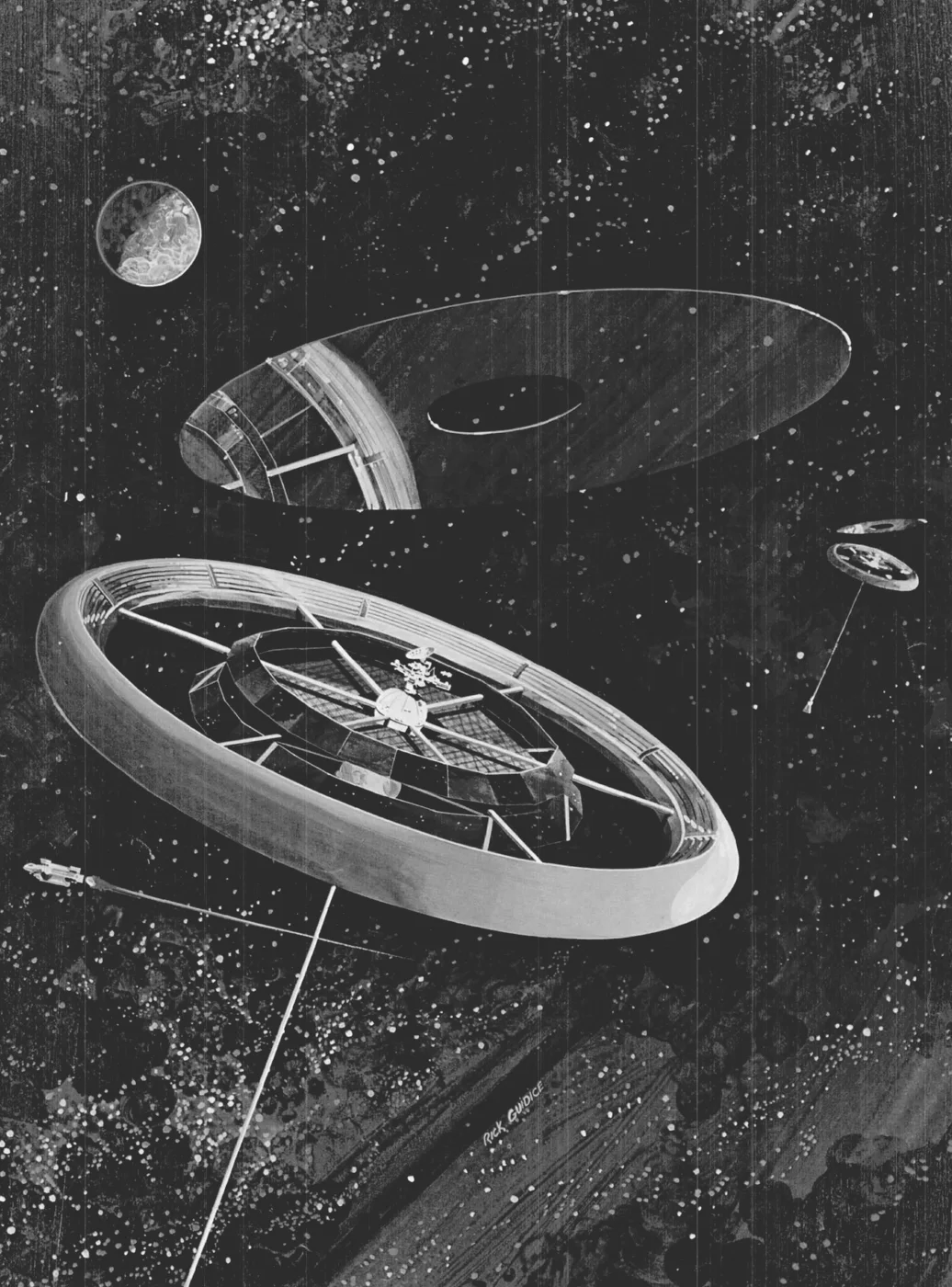
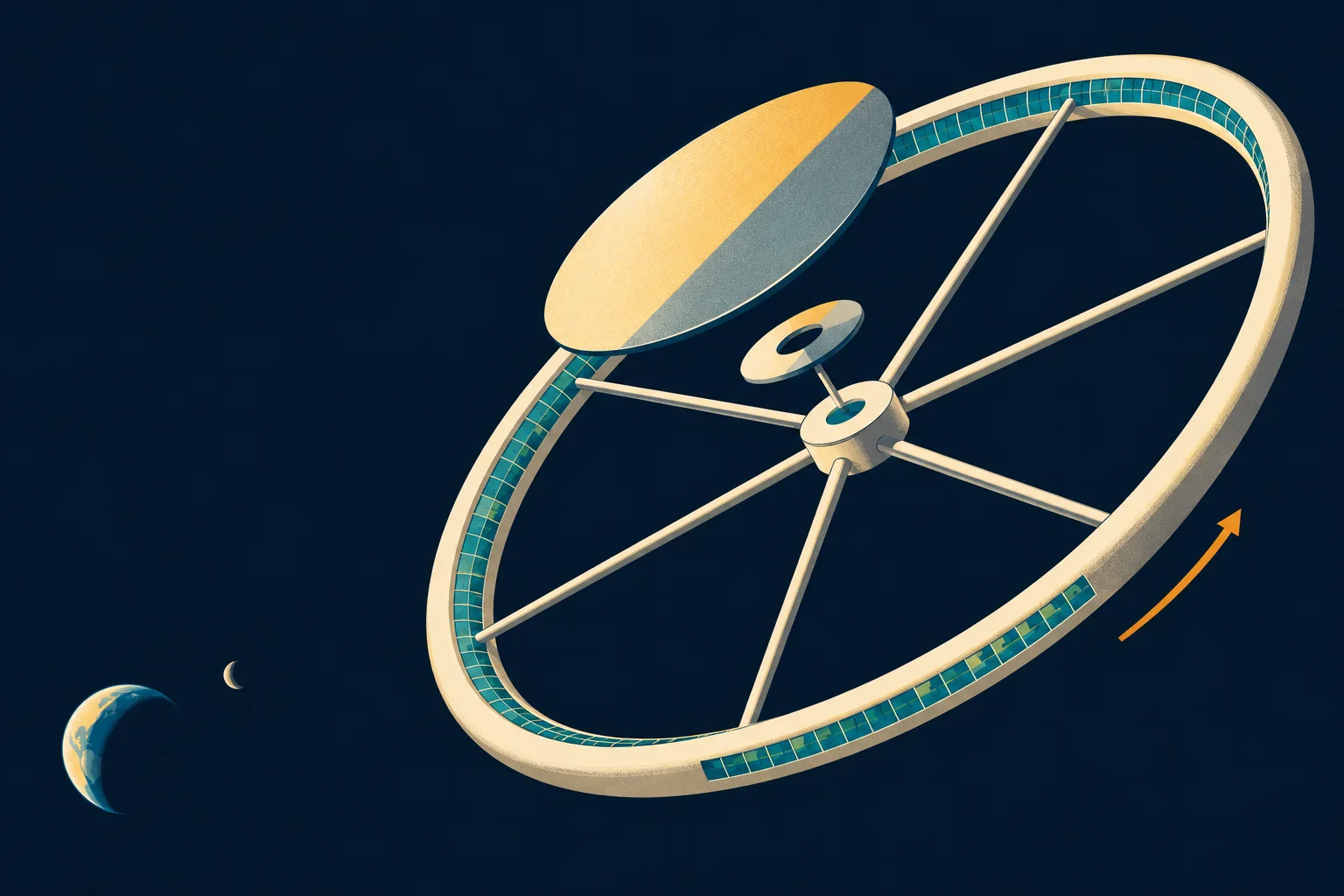
The overall system. 10,000 people live in a tube 130 m across, bent into a wheel 1,790 m in diameter, orbiting at the Lagrangian point L5, equidistant from Earth and Moon. Six spokes 15 m across connect the rim to a central hub where ships dock. The whole habitat turns once a minute to give Earth-normal weight. A stationary mirror above the hub, inclined at 45° to the axis, sends sunlight onto a second set of mirrors and then through louvred, radiation-blocking mirrors into the tube. Farms of 63 ha feed everyone, and a large radiator below the hub sheds waste heat (p. 1).
Solar energy and lunar matter are the two keys. The colonists refine aluminium, titanium and silicon from lunar ore shipped cheaply into space, and use them to build satellite solar power stations for Earth and further colonies (p. 1).
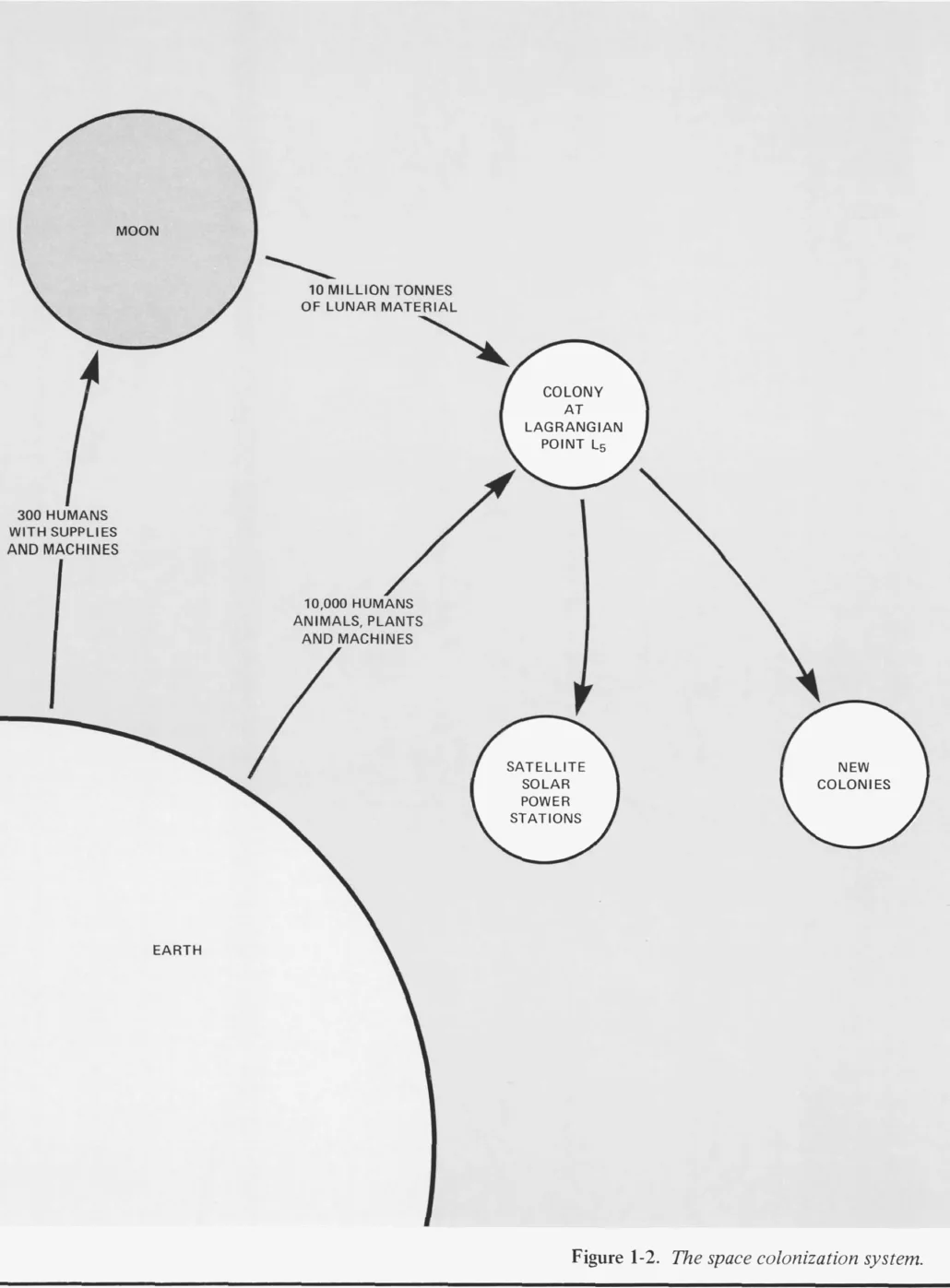
Design goals. The main goal is a permanent community productive enough to maintain itself and to grow and replicate. Four subsidiary goals follow, all using existing technology and at minimum cost: meet every physiological need and foster a viable community; secure and process raw materials; provide transport for people, materials and trade; and develop enough commerce to attract capital (pp. 1, 4).
The history of an idea. A short survey runs from Edward Everett Hale's Brick Moon (1869) through Tsiolkovsky's rotating, solar-powered station with a greenhouse (1903), Noordung's 30-m Wohnrad (1929), von Braun's 76-m wheel (1952) and Cole's hollowed asteroid (1963), to O'Neill's Princeton work from 1969 (pp. 4–5).
2 · Physical Properties of Spacepp. 9–18
This chapter turns the environment into design criteria. Space is described as rich in paradoxes: empty yet full of energy and matter, featureless yet shaped by gravity (p. 9).
The topography of spacepp. 9–10
Each planet or moon sits at the bottom of a gravity well, and Earth's is 22 times deeper than the Moon's. The five Earth–Moon libration points are shallower wells. L1, L2 and L3 are saddle-shaped and unstable; L4 and L5 are bowl-shaped, and when the Sun is included, objects near them follow stable orbits with a period of about a month (pp. 9–10).
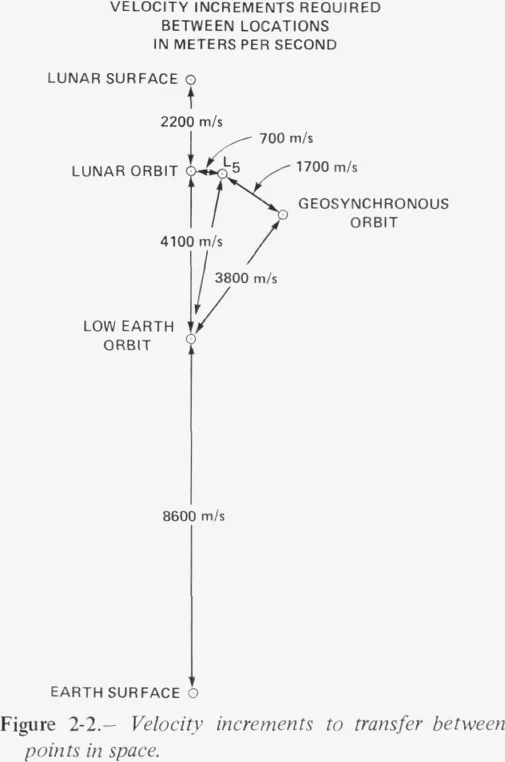
Distance and effort are not the same thing. Going from low Earth orbit to lunar orbit takes about 5 days but needs a velocity change of 4,100 m/s, only 300 m/s more than reaching geosynchronous orbit. Most of the effort near Earth goes into the first 100 km (p. 10).
Solar radiation: an abundant and essential source of energyp. 11
A square metre facing the Sun receives 1,390 W, nearly twice the 747 W maximum at Earth's surface, and almost 7.5 times the average over the whole Earth once night and slant are counted. Converted at 10 percent and sold at $0.012/kWh, one square kilometre of sunlight would earn more than $14 million a year (p. 11).
Matter in space: a major resourcepp. 11–18
The Moon is the chosen source: close by, in a shallow well, and rich in aluminium, titanium, iron, oxygen and silicon, though poor in hydrogen, carbon and nitrogen, which must come from Earth. Asteroids, some possibly carrying water and carbon, are flagged as a likely later resource (pp. 11–12).
Meteoroids are judged a small hazard. A square kilometre is crossed by a 1-g meteoroid about once every 10 years and by a 100-g one about once in 5,000 years. A 1-m hole, expected once in 10 million years, would take at least a day to let out 60 percent of the air (pp. 12–13, Appendix A, Table 2-1).
Ionizing radiation is the major threat. Unshielded, galactic cosmic rays deliver about 10 rem a year, and heavy nuclei such as iron destroy columns of cells along their tracks. Solar flares of the 1956 class could give many times a fatal dose to an unprotected person. A thin shield of a few tonnes per square metre can increase the dose, to as much as 20 rem a year, because of secondary particles. For reference the report cites 5 rem/yr for radiation workers, under 0.5 rem/yr for the general population, and about 0.1 rem/yr as a typical natural background (pp. 13–15, Appendix B).
3 · Human Needs in Spacepp. 21–35
Because the effects of large departures from Earth conditions are unknown, the study chose to keep living conditions Earth-like despite additional costs (p. 21). That choice drives the size and mass of everything that follows.
Weightlessness: pseudogravity is neededpp. 21–22
Spaceflight so far had shown bone decalcification of 1–2 percent a month with no sign of levelling off, along with hormone and fluid changes and a difficult readaptation to 1 g. With no data between 0 and 1 g, the study set its criterion at 0.9 to 1 g (pp. 21–22).
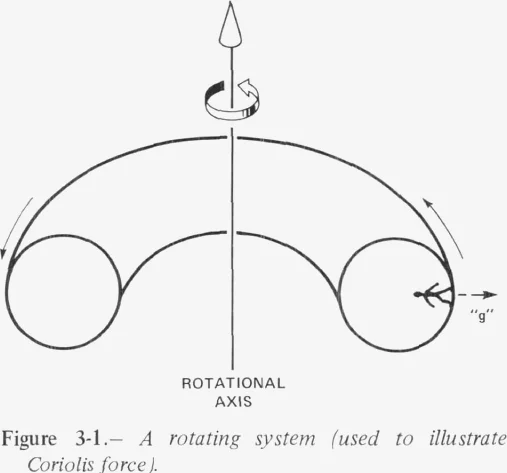
Rotation brings Coriolis forces. Someone jumping 0.55 m off the mid-deck of the torus lands about 5.3 cm to one side, and head movements out of the plane of rotation can cause motion sickness. People can adapt to about 3 rpm, but adaptation may suffer from frequent changes of rate, for example by commuters to zero-g workplaces. The study therefore set 1 rpm as the upper limit for living quarters (p. 22).
Atmosphere: less is enough; food and waterp. 23
Breathing needs oxygen at a partial pressure near sea level's 22.7 kPa, within about ±9 kPa. Nitrogen is added as an inert buffer, perhaps at 26.7 kPa; carbon dioxide stays below 0.4 kPa; temperature near 22 °C at about 40 percent humidity. The result is that people can live comfortably at a total pressure well below one atmosphere. A diet for heavy work is about 3,000 Cal a day, including 2 kg of water (p. 23).
Environmental design, space needs, and small size and isolationpp. 23–28
The habitat should avoid motel banality: long lines of sight, parts hidden from each other, living things, contact with the outside, and an interior that the colonists finish themselves from modular parts. The literature suggests at least 40 m² of projected area per person, where projected area is floor area projected onto a plane perpendicular to the pseudogravity (p. 24). A land-use inventory (Table 3-2) gives 47 m² and 823 m³ per person for the community and another 20 m² and 915 m³ for agriculture (p. 25).
A town of 10,000 cannot be self-sufficient: the report cites estimates that a full range of commercial services needs 100,000 to 200,000 people. Trade with Earth, electronic communication, a route home for those who want it and a governance able to protect a fragile habitat are all treated as design requirements (pp. 25–28).
Summary of design criteriap. 28
| Criterion | Value |
|---|---|
| Pseudogravity | 0.95 ± 0.05 g (0.9–1 g) |
| Rotation rate | ≤ 1 rpm |
| Radiation, general population | ≤ 0.5 rem/yr |
| Magnetic field | ≤ 100 μT |
| Temperature | 23 ± 8 °C |
| pO₂ | 22.7 ± 9 kPa (170 ± 70 mm Hg) |
| p(inert gas, most likely N₂) | 26.7–78.9 kPa (200–590 mm Hg) |
| pCO₂ | < 0.4 kPa (< 3 mm Hg) |
| pH₂O | 1.00 ± 0.33 kPa (7.5 ± 2.5 mm Hg) |
Pseudogravity range as stated on pp. 22 and 47.
| Item | Value |
|---|---|
| Population: men, women, children | 10,000 |
| Community and residential projected area per person | 47 m² |
| Agricultural projected area per person | 20 m² |
| Community and residential volume per person | 823 m³ |
| Agricultural volume per person | 915 m³ |
4 · Choosing Among Alternativespp. 39–86
Why a torus, why L5, why the Moon? This chapter answers by comparing alternatives against the criteria. The authors note that in ten weeks they could assemble only one reasonably consistent picture, with no time to iterate toward an optimum, and that a rejected alternative is not necessarily a flawed one (p. 39).
The shape of the habitatpp. 39–43
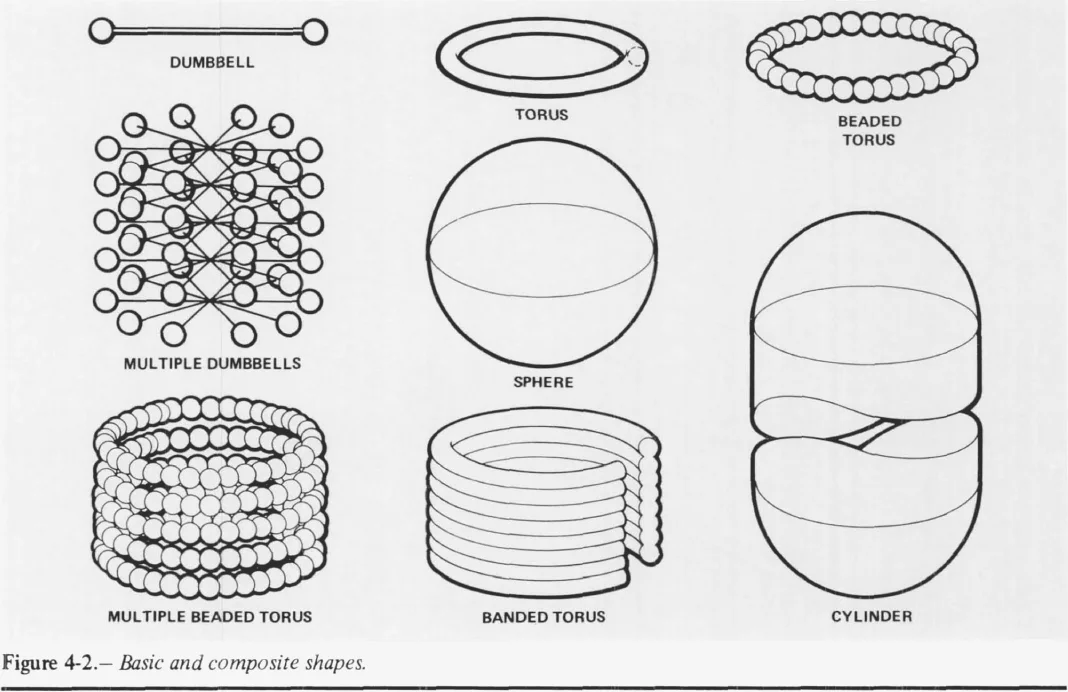
The habitat must hold about 670,000 m² of projected area, which is 67 m² for each of 10,000 people (p. 40, Appendix B). To hold air economically the shell must be a membrane in pure tension, so it must be a closed, doubly symmetric shell of revolution. That leaves four basic shapes and their composites: sphere, cylinder, torus and dumbbell (pp. 40–41). Aluminium is assumed throughout.
Pseudogravity at radius for a spin rate is . At 1 rpm ( rad/s), 1 g requires a radius of 895 m, so only systems with radii of rotation greater than 895 m can give 1 g below 1 rpm (p. 41):
For the torus this is the outermost floor: major radius 830 m plus minor radius 65 m (p. 111).
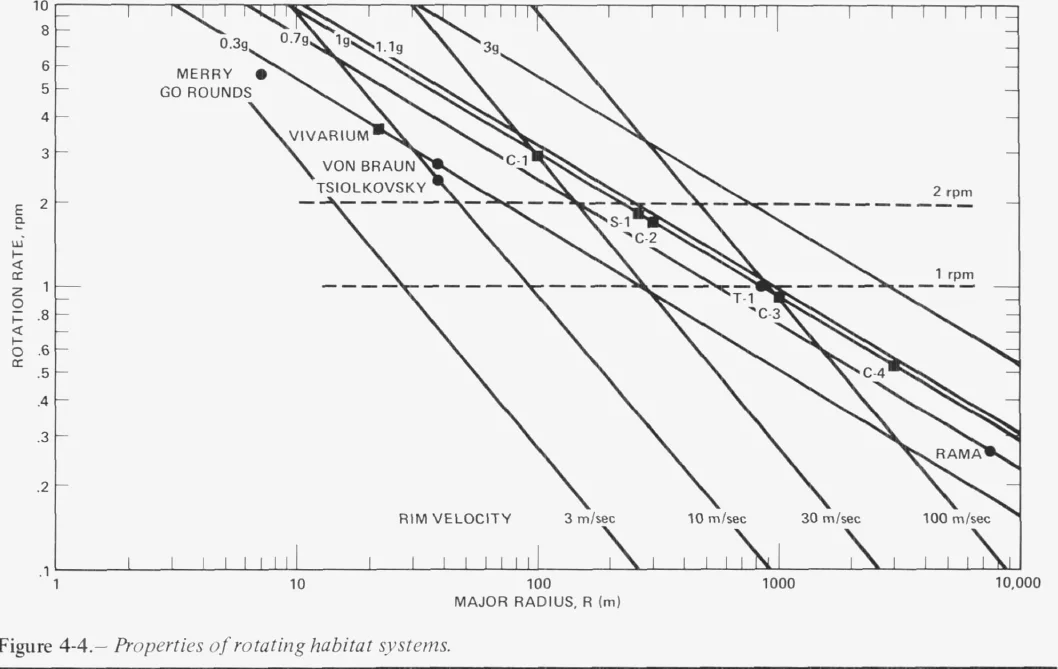
Mass decides between shapes. A cylinder like O'Neill's C-3 would weigh about 42,300 kt and hold 800,000 people; a 895-m sphere about 3,545 kt for 75,000. A torus can choose its tube radius independently of its spin radius, so a torus of 830 m and 65 m radii needs only about 150 kt. For a given radius of rotation, cylinders and spheres need about four times as much mass per unit of projected area as a slim torus (pp. 41–42, Appendix C).
| Single torus 830/65 m | Cylinder R 895, L 8,950 m | Sphere R 895 m | Dumbbell R 895 m | Banded torus 880/15 m | |
|---|---|---|---|---|---|
| Structural mass at ½ atm, kt | 150 | 42,300 | 3,545 | 380 | 112 |
| Projected area, m² | 6.8 × 10⁵ | 550 × 10⁵ | 50.3 × 10⁵ | 6.3 × 10⁵ | 6.6 × 10⁵ |
| Shielding mass, Mt | 9.9 | 23.3 | 46.7 | 33.5 | 7.0 |
| Volume, m³ | 6.9 × 10⁷ | 2,265 × 10⁷ | 300 × 10⁷ | 13.2 × 10⁷ | 2.1 × 10⁷ |
| Mass of atmosphere, kt | 44 | 14,612 | 1,930 | 85 | 13.2 |
| Longest line of sight, m | 640 | 10,740 | 1,790 | 732 | 161 |
| Openness | Good | Good | Good | Good | Poor |
| Population at 67 m²/person | 10,000 | 820,000 | 75,000 | 10,000 | 10,000 |
Table 4-1 also lists multiple dumbbells (72 kt, 9.9 Mt) and multiple tori (100 kt, 9.7 Mt), both with poor openness.
Composite structures are lightest of all, but were set aside largely on architectural criteria of environmental perception: short sight lines and dense internal cables would feel oppressive (p. 42). The single torus is adopted for its balance of low mass, large volume, possible incremental construction, a clear circulation pattern, zero-g access at the hub and a clear visual horizon (p. 43).
Shieldingpp. 43–46
Active shields. A magnetic field can turn away particles below a cutoff energy. A cutoff of 0.5 GeV per nucleon, with about 10 kt of structure, would actually raise the dose to about 20 rem/yr through secondaries made in the structure; a 10–15 GeV cutoff would work but needs too much structure to hold the superconducting coils apart. Electrostatic shielding would need about 10 billion volts; a plasma shield is promising but needs research (pp. 43–44, Appendix D).
Passive shield. Earth's atmosphere provides about 10 t/m². Half of that would bring cosmic rays down to 0.5 rem/yr, and because many particles cross the shield at a slant, 4.5 t/m² suffices around the torus: 9.9 million tonnes in all (pp. 44, 46). Appendix E derives the thickness from a conservative formula for a thick shield of lunar soil:
= shield thickness in g/cm²; 106 g/cm² is the mean free path for nuclear collisions in silicon dioxide. Setting the dose to 0.25 rem/yr (half the criterion, allowing a factor of 2) gives g/cm², or 4.41 t/m² (p. 125).
So much mass cannot spin at 1 rpm without overstressing it, so the shield is a separate shell that is stationary or turns very slowly. The tube therefore moves past the shield's inner surface at 87 m/s, a metre or two away. The study group's consensus was that keeping them aligned would not be difficult in principle, though it was not studied in detail (p. 46).
What if the criteria change?pp. 46–48
The chapter then relaxes the criteria to show how sensitive the shape is to them. Moving the farms outside the shield and cutting the projected area from 47 to 35 m² per person shrinks every option (Table 4-2). Allowing 0.85 ± 0.15 g at 1.9 rpm instead of 0.95 ± 0.05 g at 1 rpm reduces the radius of rotation to 236 m (p. 47).
| Single torus 209/27 m | Sphere R 236 m | Banded torus 209/27 m | |
|---|---|---|---|
| Structural mass at ½ atm, kt | 4.6 | 64.6 | 26 |
| Shielding mass, Mt | 1.0 | 3.3 | 3.6 |
| Mass of atmosphere, kt | 1.9 | 35.2 | 11.3 |
| Openness | Fair | Good | Poor |
| Population at 35 m²/person | 2,000 | 10,000 | 10,000 |
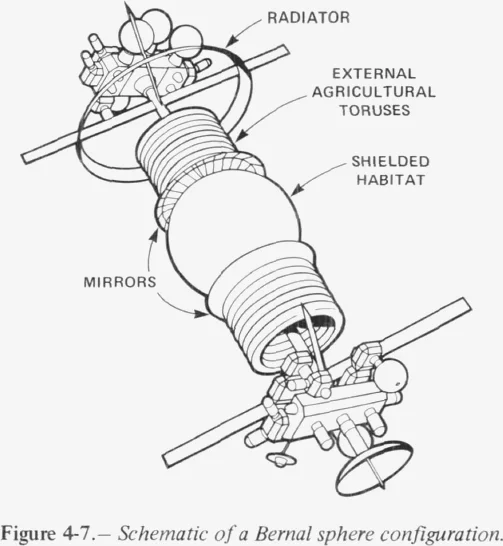
With the smaller radius a single torus is too small and a cylinder far too large, but a sphere holds exactly 10,000. The resulting Bernal sphere, with farms in thin rings outside the shield, needs 300,000 t less shielding than its nearest rival and millions of tonnes less than the rest, but 3–4 times the atmosphere and 2–4 times the structure (p. 48). Which shape wins depends on the relative cost of shielding, structure and atmosphere (p. 48).
Fabrication techniques; the people in the colonypp. 48–52
The shell is built outward from the hub, through the spokes and around the torus, by space tunneling: movable end caps advance along the tube so that workers assemble prefabricated parts in shirt-sleeve conditions. Metal-vapour deposition onto a rotating form is suggested for study. Inside, a light tubular frame with non-load-bearing walls and prepackaged bathrooms is preferred (pp. 48–49).
The population is designed too. It grows from about 2,000 construction workers who bring one to three family members each, and is weighted toward ages 21–44 and toward workers, like a frontier population. About 61 percent of the workforce, or nearly 44 percent of all colonists, produce for export (pp. 51–52). Governance is expected to start as familiar corporate or governmental management and evolve as a community identity forms (p. 52).
Life supportpp. 52–54
Food from Earth at 1.67 t per person per year would cost about $7 billion a year to ship, so food is grown in space, using familiar crops and animals rather than algae. All wastes are recycled by wet oxidation at 1,500 lb/in² and 260 °C, which in about 1½ hours yields sterile water, carbon dioxide and ash. The atmosphere is set at the minimum pressure that meets the criteria (pp. 52–53):
| Gas | kPa | mm Hg |
|---|---|---|
| O₂ | 22.7 | 170 |
| N₂ | 26.6 | 200 |
| CO₂ | < 0.4 | < 3 |
| Water vapour | 1.0 | 7.5 |
| Total pressure | 50.8 | 380 |
T = 20 ± 5 °C; relative humidity 50 ± 10 percent. Oxygen comes from lunar ore; nitrogen must come from Earth, which is one reason to keep the habitat's volume small.
Satellite solar power stations; where the colony should be locatedpp. 54–55
The study found no alternative to building satellite solar power stations as the colony's main business, and the authors note that the design depends entirely on this one enterprise, with smaller manufactures and new colonies as additions. Both Woodcock's turbogenerator design and Glaser's photovoltaic design were considered; the former was favoured as current technology (p. 54).
The habitat goes near the Moon but not on it: the lunar surface gets full sun only part of the time, offers no choice of gravity, and is a poor place to ship power stations from. Orbits close to Earth or Moon suffer eclipses; L1–L3 need station-keeping; L5 was chosen over L4 somewhat arbitrarily (pp. 54–55).
Mining, transport, and processing in space; the transport systempp. 55–62
About 10 million tonnes are needed, nearly all from the Moon. Processing happens at L5 rather than on the Moon, because the shield needs more mass than the plant's slag anyway, and because at L5 there is constant sunlight, efficient radiators and no weight (p. 56). Aluminium is extracted from anorthosite by melt-quench-leach and electrolysis of aluminium chloride; titanium from ilmenite is recommended for further study; glass is made from lunar silica (pp. 56–59).
Launch is by electromagnetic mass driver: superconducting buckets carry tens of kilograms of compacted soil, accelerated at about 30 g, with release velocity controlled to better than m/s at one to five buckets a second. A hydrogen gas gun was considered and kept for further study (p. 59). The stream goes to an active catcher at L2 rather than L5, to keep it away from the colony, to shorten the shot, and to keep the launcher on the near side (p. 59).
From Earth, about a million tonnes must be launched over 6–10 years. A shuttle-derived heavy-lift vehicle with four solid boosters carries 150 t for under $20 million per launch; beyond orbit, tugs use the space shuttle main engine, with oxygen from lunar ore at L5 (pp. 60–62, Figs. 4-14 and 4-15).
5 · A Tour of the Colonypp. 87–137
Chapter 5 alternates an italic visitor's narrative with technical description. The trip begins with quarantine, a heavy-lift launch to a 240-km orbit and a 5-day transfer to L5 in an interorbit vehicle (p. 87).
The habitat at L5pp. 87–103
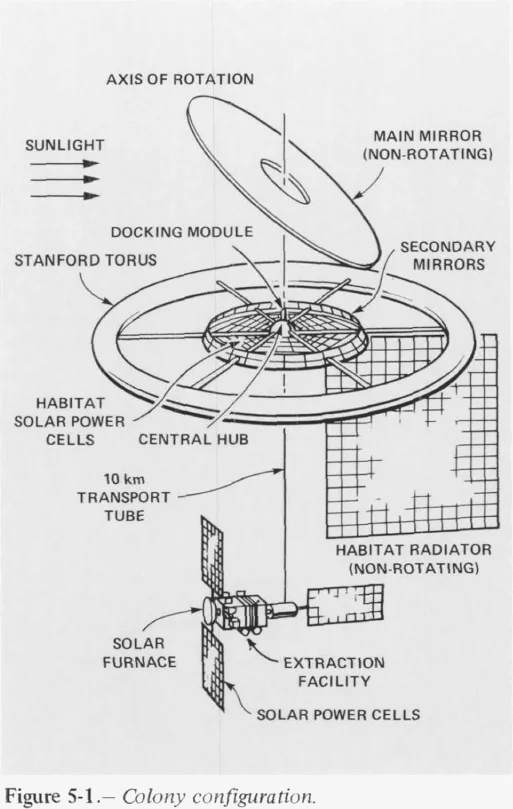
The tube is 130 m in diameter, the wheel about 1,800 m. Glass on aluminium ribs covers a third of the tube's surface and admits light downward onto farms and homes; the rest is aluminium plate. The separate shield is 1.7 m of fused lunar-soil bricks with a gap of about 1.5 m. Over the windows it becomes mirrored chevrons that pass light by successive reflections but stop cosmic rays (p. 89, Appendix K).
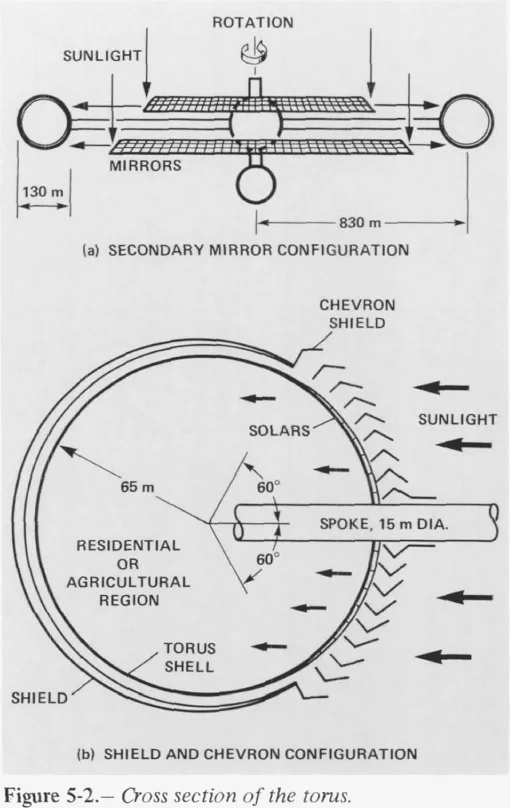
Sunlight in space is 1,400 W/m², but homes need about 200 W/m² and fields up to 1,000. Individually steered secondary mirror segments provide a day–night cycle for homes and continuous light for some crops (p. 89). If the shield served as the reaction mass for spin-up, it would counter-rotate at about 0.07 rpm (p. 89).
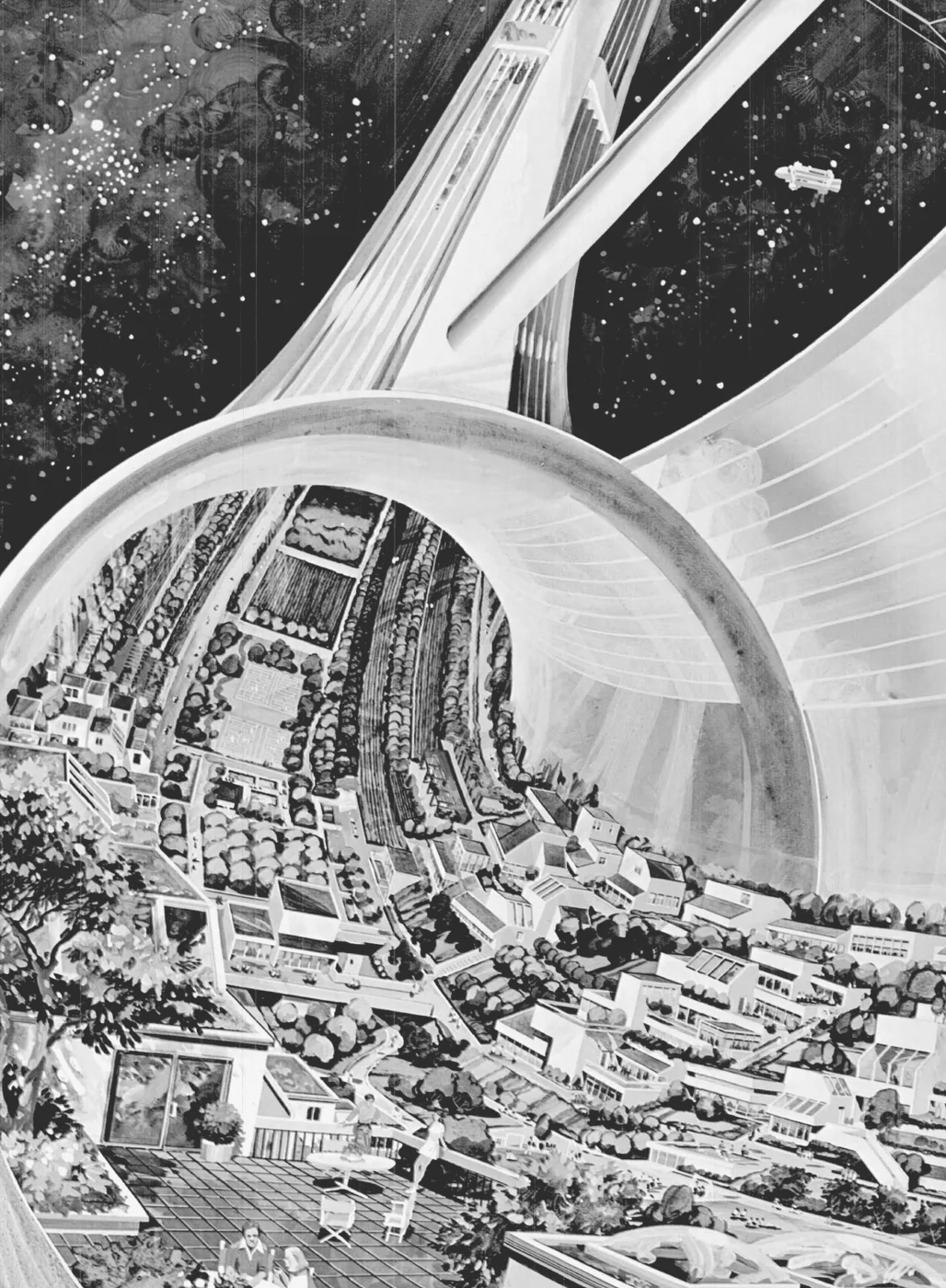
Housing for 10,000 occupies 43 ha by terracing up the curved walls and putting shops, light industry and machinery on levels below the central plain. The torus offers 678,000 m² of projected area and encloses 69 million m³; the 18 million m³ actually needed is only 26 percent of it, and the rest makes the colony feel less crowded (p. 91).
| Surface area, m² | Projected area, m² | Volume, m³ | |
|---|---|---|---|
| Community area | 980,000 | 430,000 | 8 × 10⁶ |
| Agriculture, processing and mechanical | 650,000 | 240,000 | 10 × 10⁶ |
| Total required | 1,680,000 | 670,000 | 18 × 10⁶ |
| Total available | — | 678,000 | 69 × 10⁶ |
The shell. The aluminium shell must hold 50 kPa of air, its own spin load and 530,000 t of soil, water, buildings and people. Appendix A sizes the skin of a stressed-skin torus in the meridional and hoop directions:
kPa air pressure, kPa the internal mass expressed as a pressure on the floor, m, m, aluminium with t/m³ and working stress MPa. The report gives cm and cm, and a stressed-skin mass t (p. 111).
Because a third of the surface is ribbed window, the report takes the shell mass as two-thirds stressed skin plus one-third fully ribbed (229,000 t), or 156,000 t. The windows, 2.8 cm thick across 0.5 m between ribs, add 48,000 t of glass (pp. 94, 112).
| Item | From lunar ore, t | From Earth, t |
|---|---|---|
| Shield | 9,900,000 | — |
| Torus shell | 156,000 | — |
| Glass solars | 48,000 | — |
| Spokes | 2,400 | — |
| Central hub | 1,600 | — |
| Docking module | 100 | — |
| Fabrication sphere | — | 500 |
| Radiators | 2,400 | — |
| Habitat power station | 700 | — |
| Main mirror | 200 | 7 (Mylar) |
| Secondary mirrors | 90 | 3 (Mylar) |
Internal masses (Table 5-3): soil 220,000 t (a million square metres, 0.3 m deep), water 42,000 t, biomass 6,500 t, structures and substructures 92,000 t, furniture, machinery and utilities 89,500 t, and 80,000 t extra: 530,000 t in all.
Agriculture. Three farm zones alternate with three residential areas, each zone sealed so that it can run hot, humid and CO₂-rich. Tiers of fish ponds, grain fields and livestock triple the cropland. Lunar soil foamed into a light growth matrix 0.3 m deep, year-round sun, extra CO₂ and control of pests and weather are expected to give about 10 times the yield of a typical American farm. The colony feeds 10,000 people from 61 ha (pp. 95–98).
| Crop | Required, g/person/day | Yield, g/m²/day | Area, m²/person |
|---|---|---|---|
| Sorghum | 317 | 83 | 3.8 |
| Soybeans | 470 | 20 | 23.5 |
| Wheat | 225 | 31 | 7.2 |
| Rice | 125 | 35 | 3.6 |
| Corn | 50 | 58 | 0.9 |
| Vegetables | 687 | 132 | 5.2 |
| Totals | 1,874 | 44.2 |
Grains and soybeans as dry weight. Fruit trees in the residential areas supply another 250 g per person per day. Animals (fish, chickens, rabbits, cattle) need 5.1 m² per person (Table 5-5).
Water, waste and heat. Drinking water is condensed from the humid air, 95 percent of it transpired by plants. The water system supplies 25 times the metabolic need, recycles 250 kg per person per day for waste transport, and still uses only 75 percent of U.S. domestic water use (p. 101). Electricity is set at 3 kW per person, twice the U.S. figure, to cover recycling. The radiator sheds 131 MW: at 280 K a black body radiates 348 W/m², so a 60-percent-effective radiator needs 6.3 × 10⁵ m², and 50 percent more for peak loads gives 9.4 × 10⁵ m² and 2,400 t (pp. 102–103).
Production at L5pp. 103–106
Heavy processing sits in an extraction plant 10 km south of the hub with its own solar furnaces and a 200-MW solar power station. Its aluminium line melts lunar soil at 2,000 K, quenches it to glass, leaches it with sulfuric acid and ends with electrolysis of aluminium chloride; it produces about 150 t of aluminium a day, or 54 kt a year, with a plant of 7,620 t (pp. 103–105, Tables 5-9 to 5-12).
Building a 10-GW thermal power station is estimated at 2,950 man-years of off-Earth labour (Table 5-7, p. 104). Satellite repair, metal foams and single crystals are noted as smaller lines of business (p. 104).
The lunar basepp. 106–108
The mine is at the Apollo 16 site in the Cayley area, where Apollo samples had the most aluminium. Supplying a million tonnes a year means scooping an area about the size of eight football fields each year at about 4 t a minute. 150 people live there on two-year tours, under 5 m of lunar soil (pp. 106–107).
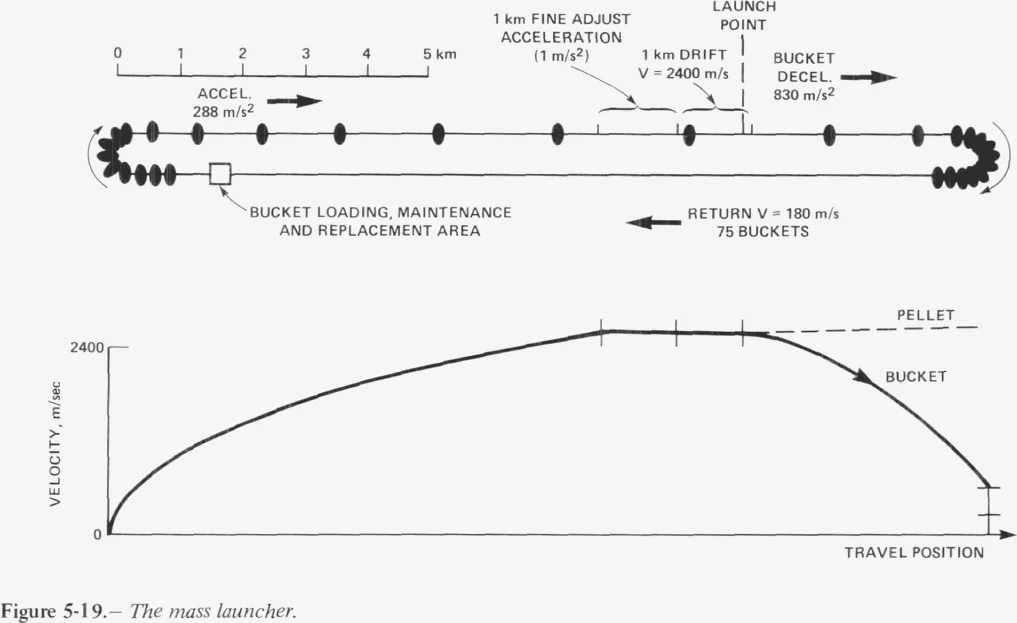
The mass launcher fires five 10-kg payloads a second at lunar escape velocity, 2,400 m/s, with the launch velocity held to within m/s along track and m/s across. Buckets accelerate at 288 m/s² over 10 km, release their loads, decelerate and return. At a 70 percent duty cycle it launches 1.1 million tonnes a year; two launchers and 220 MW of nuclear power keep it running through the lunar night (pp. 107–108, Appendix F).
Acceleration and track length from Fig. 5-19 and Appendix F (p. 126).
The mass catcher at L2; home to Earthpp. 108–110
Payloads arrive at L2 as sintered blocks 0.20 m across, each 10 kg, at 200 m/s. A light net steered by three cables can be placed anywhere in a triangle 1 km on a side; the catcher weighs 220 t. A rotary pellet launcher, a fast-spinning 30-m tube that flings rock pellets at up to 4,000 m/s, keeps it pointed and absorbs the stream's push of about 2,000 N, using 5 percent of the received mass. Ore carriers take about two months from L2 to L5 (pp. 108–110).
The visitor leaves after two months and 750,000 km, wondering whether the colony will flourish: only time will tell (p. 110).
6 · Building the Colony and Making It Prosperpp. 139–169
Research and pilot plants come first: on Earth, then in low Earth orbit (which offers vacuum and zero g at a quarter of the cost of L5), with minimal early lunar work. Physiology under rotation and reduced pressure, and closed ecologies, are named as needing basic research (pp. 139–142).
Sizing rules: habitats at 5 t per person (7 t on the Moon), resupply of 1.7 t per person per year during construction, lunar mass flow sized to finish the shield in 10 years (1.2 million t/yr), and processing plants sized to finish the shell in 6 years, each plant producing about 8.3 times its own mass per year (p. 144). Development is costed at $5,000 per kg (Apollo was $14,000/kg) and purchase at $500 per kg (p. 145).
The schedule allows 5 years of research on Earth, 3–5 years of development in Earth orbit, 5 years to build up the Moon base and L5, 6 years for the habitat and 4 years to finish the shield and bring in the colonists: 22 years in all (p. 147).
| Category | Cost, $B |
|---|---|
| Research | 1.6 |
| Development to first unit | 28.5 |
| Production | 14.6 |
| Transportation | 114.3 |
| Subtotal | 159.0 |
| Miscellaneous and administration (20%) | 31.8 |
| Total | 190.8 |
Transportation is more than half the total, and falls after year 12 when oxygen from lunar ore becomes available as propellant.
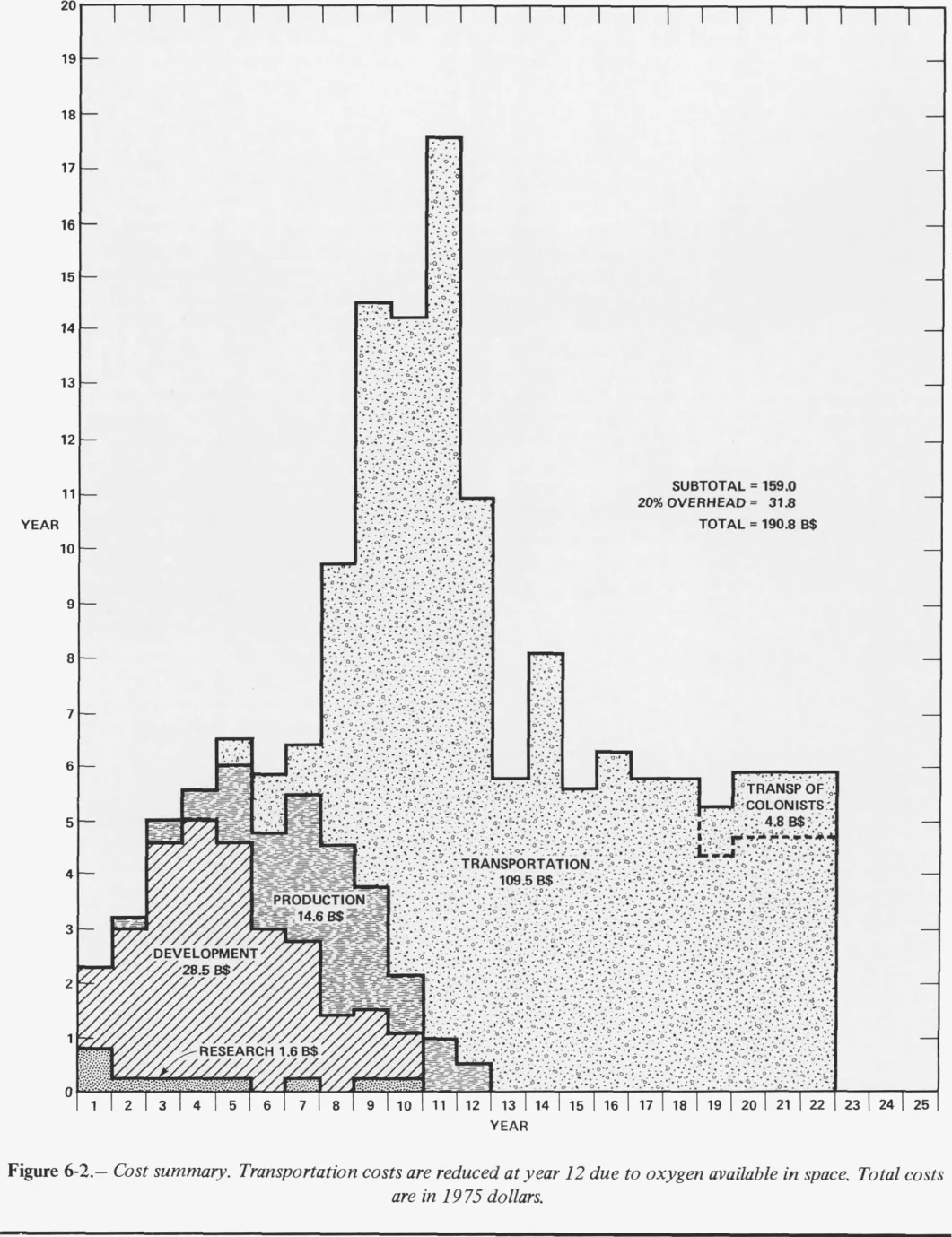
Energy as the economic justification. A modified plan builds construction shacks first, then power stations and the colony in parallel, with a lunar power satellite to run the mass drivers. The market is assumed to be new U.S. generating capacity plus half as much abroad, penetrated over ten years and growing 5 percent a year. Through the first colony the program costs $196.9 billion. Annual benefits exceed costs by year 28, busbar electricity costs fall from 8.5 mils/kWh in year 22 to 4.8 by year 70, and the benefit-to-cost ratio is 1.02 at a 10 percent discount rate or 1.5 at 8 percent (pp. 152–155). Starting a second-generation shuttle in year 3 rather than 15 would raise the ratio to 1.3 and lower the first colony's cost to $112.7 billion (p. 155).
7 · View to the Futurepp. 171–176
Dropping the near-term-technology rule, the report sketches what could follow: space-built communication platforms, titanium lifting bodies gliding cargo down to Earth, giant telescopes and research ships built at L5, kilometres-long mass-driver engines exhausting lunar oxygen, and carbon, hydrogen and nitrogen from carbonaceous asteroids, about as far from L5 in Δv as Earth's surface (pp. 171–173).
Criteria may relax with experience: 0.7–1.0 g, and a 36-kPa atmosphere of half oxygen, half nitrogen. A Bernal sphere 900 m in radius at 1 rpm would weigh 5 million tonnes, need a 60-million-tonne shield and house about 140,000 people at the baseline density. With productivity of 100 t per person-year, 12 percent of its people could duplicate it in 3 years, which sets an upper limit of 56 years to house a population equal to Earth's (pp. 174–175).
8 · Recommendations and Conclusionspp. 179–182
Missing data forced conservative assumptions, with considerable weight, size and cost penalties (p. 179). The first research recommendations address exactly those assumptions:
- Acceptable radiation dose: 0.5 rem/yr was chosen as a conservative measure and drives the shield (p. 179).
- Acceptable g levels: 1 g may be unnecessarily high; partial-g physiology should be studied on Spacelab and later stations (p. 179).
- Maximum rotation rate: together with g it largely sets the colony's size (p. 179).
- Closure of the life support system, and intensive agriculture at the yields assumed (p. 179).
- Radiation shielding methods, especially the plasma shield; productivity in space; lunar ore and glass processing; the mass launcher and mass catcher; minimum nitrogen; power-station design; transport; environmental impacts; human factors; institutions and financing; and economics (pp. 179–180).
A further 48 topics for later study run from immigrant selection and halo orbits to space viticulture and an acceptable name for the first colony (pp. 180–181). The recommended ventures are to continue the shuttle and Spacelab, start a heavy-lift vehicle, build a large orbital laboratory, set up a lunar base to test resources, and send a probe to the asteroids (p. 181).
There seems to be no insurmountable problems to prevent humans from living in space.Conclusions, p. 182
The study group's principal conclusion is that the United States, possibly with other nations, should take specific steps toward space colonization (p. 182).
Assumptions and open questions
Key assumptions
- Physiological criteria set conservatively in the absence of data: 0.9–1 g, at most 1 rpm and at most 0.5 rem/yr for everyone, including children (pp. 22, 28, 179).
- Near-term technology only, with aluminium as the structural material: a working stress of 200 MPa, two-thirds of yield, as for large civil structures (pp. 4, 63).
- A passive shield of 4.5 t/m² that is separate from the rotating torus and stationary or slowly turning, sized by the conservative Appendix E dose formula with a factor-of-2 margin (pp. 44, 46, 125).
- Agricultural yields about 10 times those of a typical American farm, from continuous light, extra CO₂ and controlled conditions (p. 98).
- A population of 10,000 weighted toward working ages, drawn from Western industrialized nations, with 44 percent producing for export (pp. 51–52).
- Labour productivity taken from 1975 terrestrial industry factors, adjusted for space; plants producing 8.3 times their own mass per year; no bootstrapping beyond pilot plants (pp. 103, 143–144).
- Costs at $5,000 per kg for development and $500 per kg for purchase, a heavy-lift launch of 150 t for under $20 million, and satellite solar power as the economic product, with electricity benefits valued against 14.1-mil nuclear power (pp. 60, 145, 155).
Where further work would help
- Gravity and spin limits. The torus's 895-m radius follows directly from 1 g at 1 rpm. Table 4-2 shows that relaxing these to 0.7–1.0 g at 1.9 rpm cuts the radius to 236 m and favours a sphere, so long-term data on partial gravity and on adaptation to faster rotation would show how firmly the chosen shape is anchored (pp. 47–48, 179).
- Radiation limits and shielding. The 9.9-million-tonne shield is most of the colony's mass. Its size depends on the dose limit, on the exponential approximation of Appendix E (stated to be good to perhaps a factor of 2), and on slant-path geometry; a fuller transport calculation and biological data on chronic dose would show how much of that mass is required (pp. 46, 125, 179).
- Relative costs of shielding, structure and atmosphere. The authors note that the choice among torus, sphere and composite shapes turns on these relative costs, which were not determined in the study (p. 48).
- Closed ecology and farm yields. The 61–63 ha of farmland rests on yields that the report notes had not yet been demonstrated in a closed loop at scale; small and then large closed-system demonstrations were recommended before colonization (pp. 98, 179).
- Lunar materials chain. Lunar glass of window quality, the aluminium and titanium extraction routes, the mass launcher's precision and the L2 catcher were all at the concept stage; the report recommends laboratory and pilot-plant work, a scaled launcher prototype, and much greater study and eventual testing in space of the catcher (pp. 58, 179–180).
- Shield–torus clearance. Keeping a 1.5 m gap between a tube moving at 87 m/s and a stationary 10-million-tonne shell was judged feasible in principle but not studied in detail (pp. 46, 181).
- Economic sensitivity. The benefit-to-cost ratio moves from 1.02 to 1.5 between 10 and 8 percent discount rates, and the first colony's cost from $196.9 billion to $112.7 billion with an earlier second-generation shuttle; productivity in space, launch costs and the electricity market would each need wider ranges explored (pp. 155, 180).
What happened next
- 1975
Summer: the ten-week NASA–ASEE program runs at Ames and Stanford (p. vii). NASA's image archive holds Rick Guidice's torus paintings that appear in the report (AC75-1086-1, AC76-1267).
- 1976
Oct 1: NASA Administrator James C. Fletcher signs the report's foreword, noting that settlement in space is not an authorized program (p. v). That summer a second Ames study, as later summarized in NASA SP-428, corroborated early estimates that such projects could be carried out with an investment comparable to Apollo's (SP-428, p. 173).
- 1977
NASA publishes the report as SP-413. The 1977 Ames Summer Study on Space Settlements and Industrialization Using Nonterrestrial Materials, directed by O'Neill, brings together forty senior researchers and ten students for six weeks (SP-428, p. iii).
- 1979
NASA SP-428, Space Resources and Space Settlements, publishes the 1977 study's papers. Its habitat group takes its 10,000-person design point directly from the 1975 study and asks how much the conservative criteria cost in structure (SP-428, pp. 33–34).
- 2011
A Marshall Space Flight Center analysis revisits the O'Neill–Glaser model and records that the plan was not adopted by any U.S. administration, probably because of high initial costs and the long time to payback (Curreri & Detweiler, NTRS 20120001744, p. 4).
Sources
- Johnson & Holbrow (eds.), Space Settlements: A Design Study, NASA SP-413 (1977) · NTRS 19770014162
- Billingham, Gilbreath & O'Leary (eds.), Space Resources and Space Settlements, NASA SP-428 (1979)
- Curreri & Detweiler, A Contemporary Analysis of the O'Neill–Glaser Model for Space-Based Solar Power and Habitat Construction (NASA MSFC, 2011)
- NASA Image Library: The Torus Wheel from 'Space Settlements: A Design Study', Rick Guidice (AC76-1267)
- NASA Image Library: Space Colonization, torus wheel interior, Rick Guidice (AC75-1086-1)