At a glance
- Category
- A NASA center engineering working paper that is part mission proposal and part parametric feasibility study: rocket-equation sizing across fuels and vehicle sizes, a program plan and vehicle count, and summaries of piloted simulations. It argues for lunar-orbit rendezvous (LOR) as much as it analyses it.
- Context
- Requested by NASA's Large Launch Vehicle Planning Group (the Golovin Committee) in a telegram of 24 August 1961 (p. 11). It builds on Langley rendezvous work going back to a December 1960 briefing. It compares itself against the Fleming plan (Nova direct ascent) and the three Heaton plans (Earth-orbit rendezvous), on the Saturn-family boosters C-1, C-3 and C-4.
- Contributions
- A complete single-launch LOR mission with an explicit velocity budget for every phase (Table I).
- A weight matrix of 3 lander sizes × 3 return-vehicle weights × 10 fuel combinations, plus four direct-landing comparisons (Tables VI–X).
- A month-by-month flight program and vehicle count set against the competing plans (Tables XI–XIII).
- Piloted-simulation results for lunar-orbit insertion, landing, rendezvous and abort.
- First-cut sizing of the lander's guidance, life support and power.
Summary and Conclusionspp. 7–10
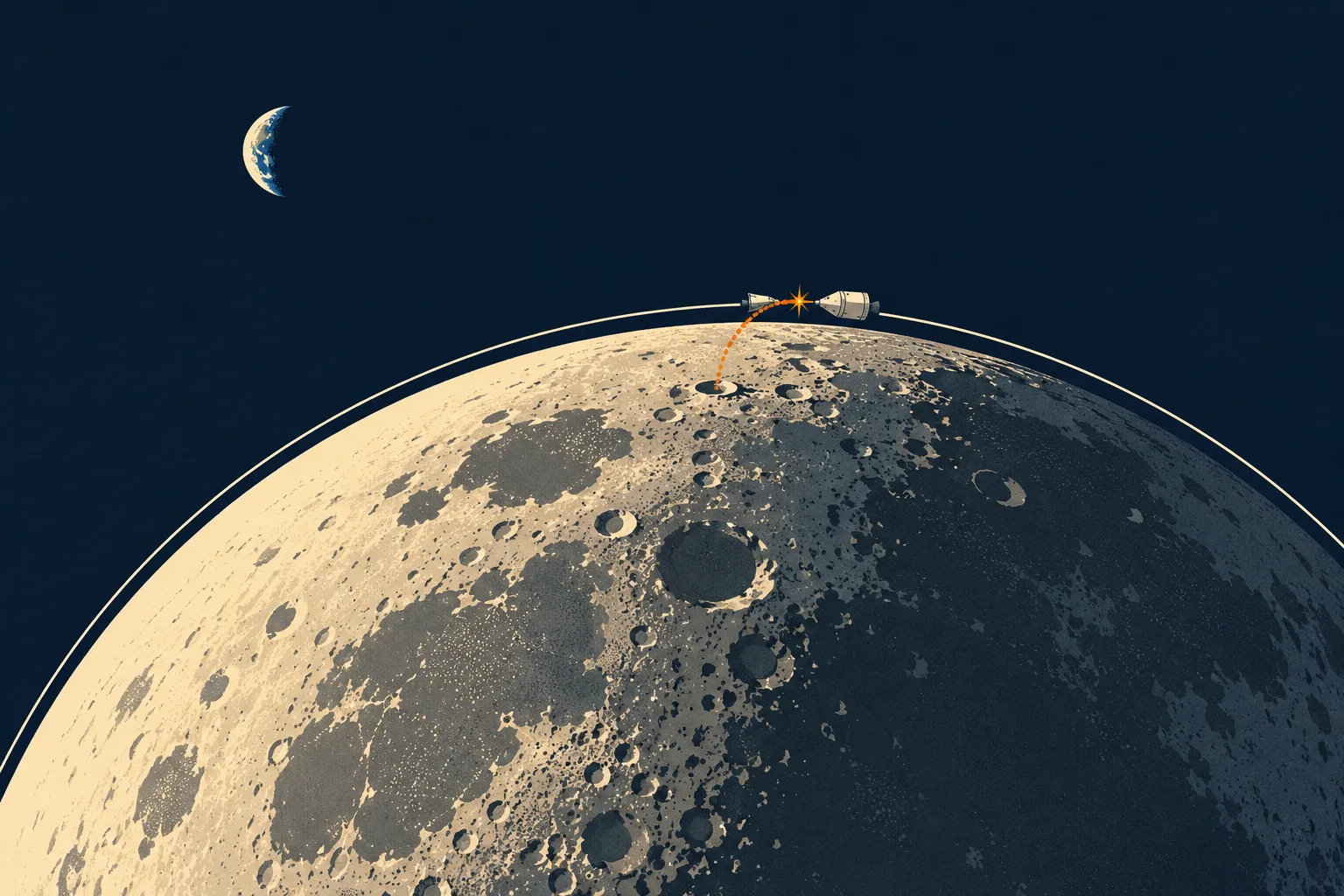
The report leads with its conclusions. LOR is called the simplest, most reliable, and quickest way to land men on the Moon. The mission fits on a single C-3 booster, with no Nova, and all development flights can use the smaller, better-developed C-1 (pp. 7–8).
This technique permits a lunar exploration to be made with a single C-3 booster.Summary and Conclusions, p. 7
- Schedule: first landing in March 1966, possibly an attempt as early as November 1965, without changing existing Apollo, C-1 or C-3 schedules.
- Cost: 20 to 40 percent fewer large boosters than the alternatives, and no Nova.
- Abort: can be provided with no additional fuel or weight penalties.
- Lander: because it never re-enters Earth's atmosphere, the lander can be optimised purely for landing, and crews can train in the actual vehicle.
Introductionp. 11
Langley had studied rendezvous for several years and LOR specifically for the past year and a half. The report puts that scattered work under one cover and lays out a full landing program, as the planning group asked. It lists the briefings that came before it, starting with the Space Task Group–Langley briefing of 10 December 1960 (p. 11).
Part I · Mission Descriptionpp. 12–17
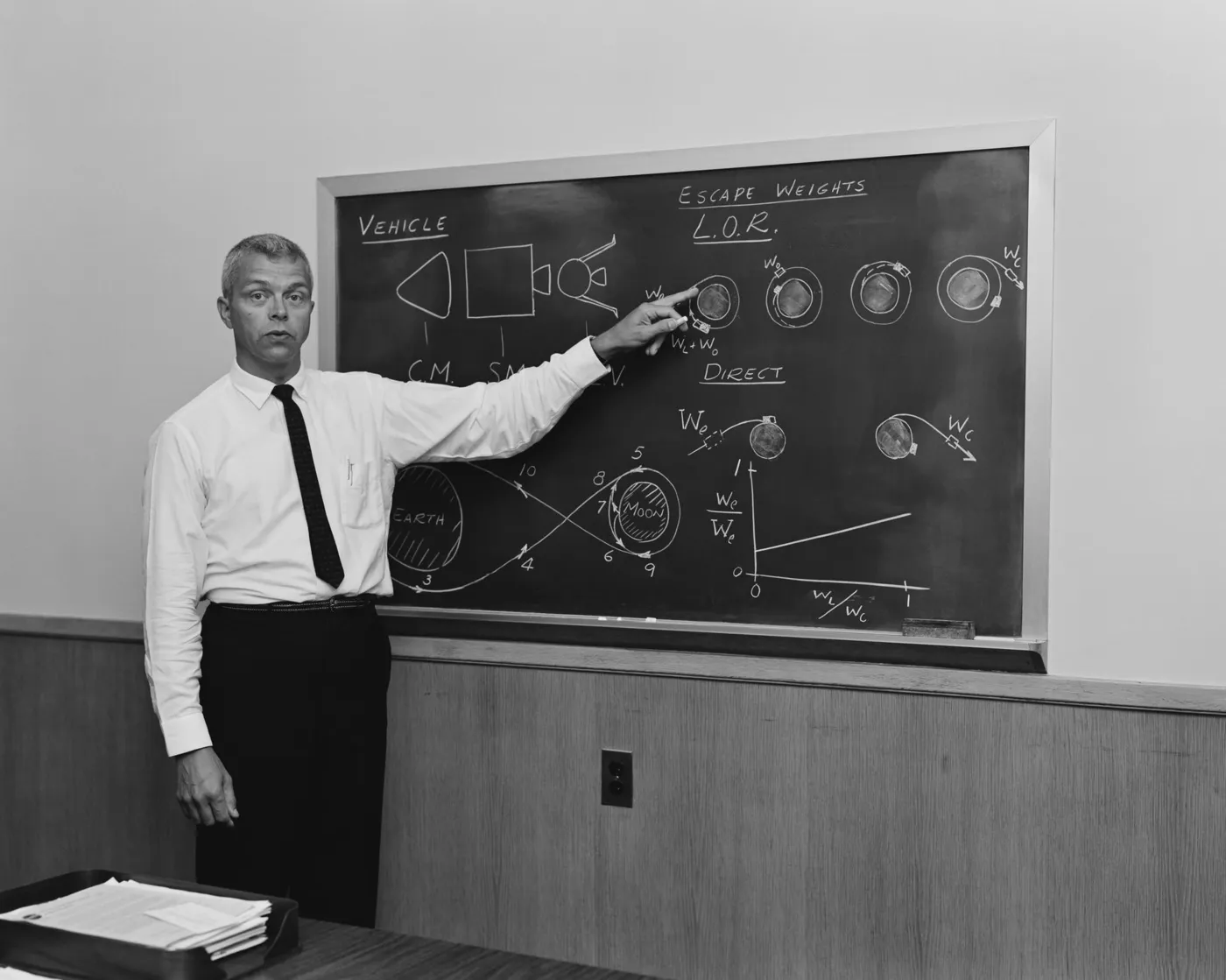
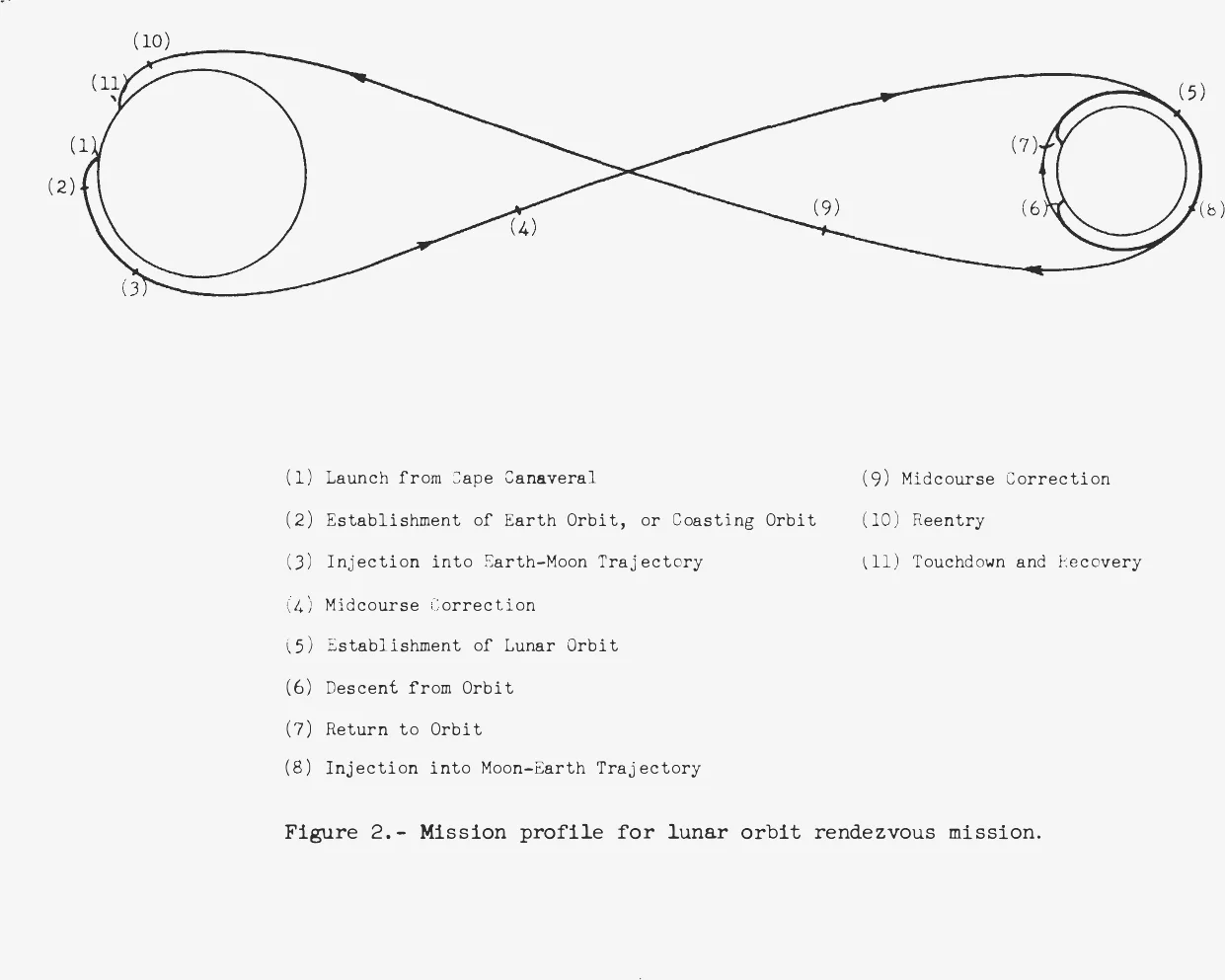
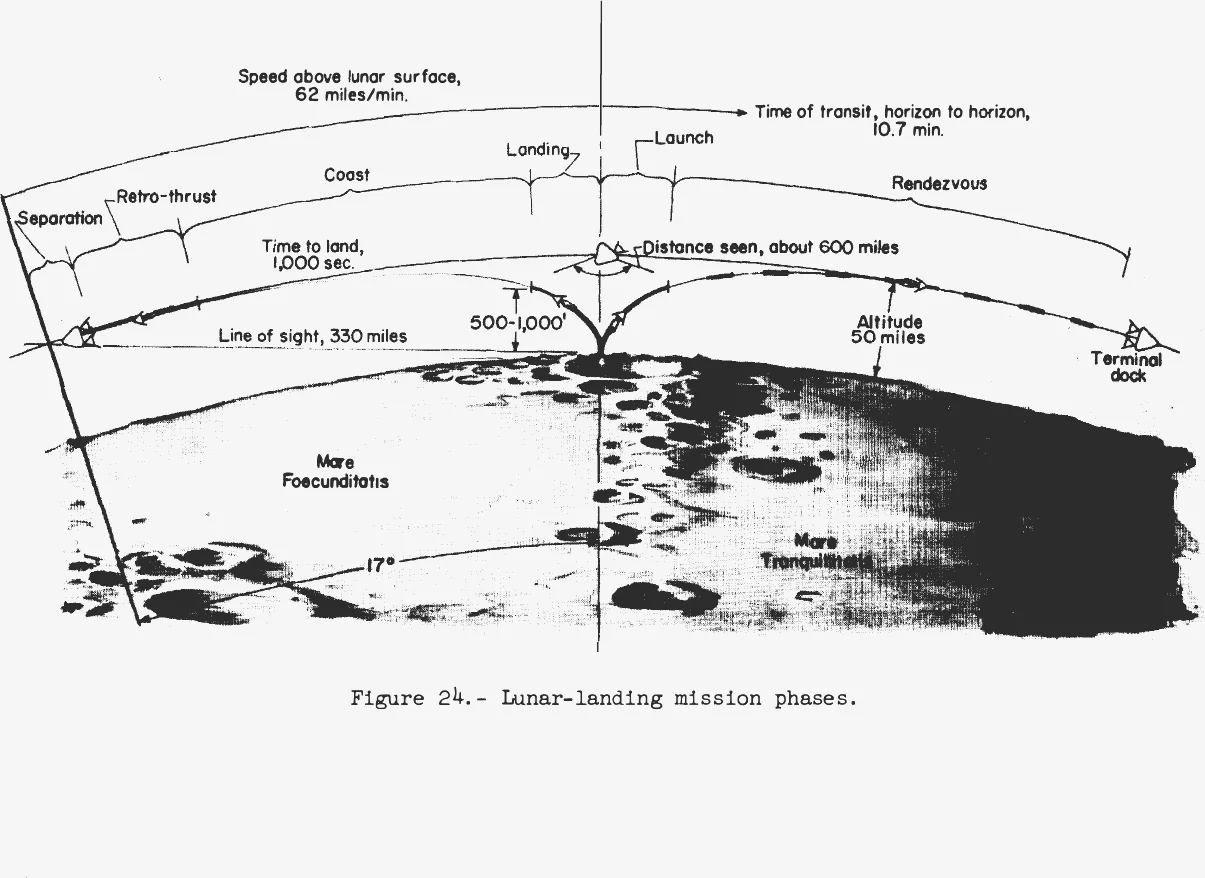
The mission has eleven phases (Fig. 2). Phases 5 to 8 are what make it LOR: brake into a low lunar orbit, send the lander down, bring it back up to rendezvous, then fire the whole remaining ship homeward. The stack is drawn in Fig. 3: lander, a blunt-cone re-entry vehicle, a braking and orbital-launch module with two spherical tanks, and an Earth-departure stage. Only the re-entry vehicle and its braking module stay in lunar orbit.
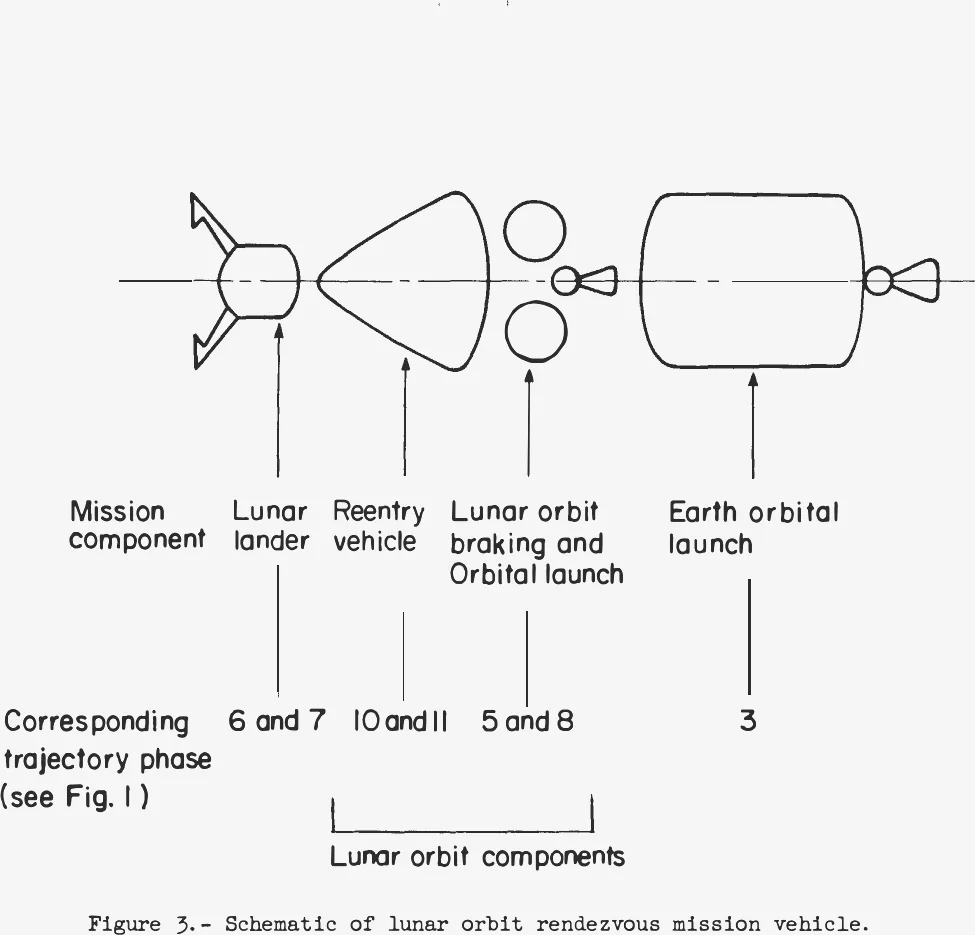
Mission profile and vehicle concept
Every phase is budgeted twice: as an ideal impulsive velocity change, and with allowances for finite thrust and pilot control. All of the sizing uses the second, more conservative column. The report says non-optimum conditions have been assumed for each phase (p. 12).
| Phase | Impulsive | Finite thrust + piloting |
|---|---|---|
| 3 · Injection into earth–moon transfer¹ | 10,183 | 11,100 |
| 4 · Midcourse correction | — | 200 |
| 5 · Establishment of lunar orbit² | 3,534 | 3,640 |
| 6 · Descent from orbit | 5,630 | 6,798 |
| 7 · Return to orbit | 5,630 | 7,468 |
| 8 · Injection into moon–earth trajectory³ | 3,175 | 3,461 |
| 9 · Midcourse correction | — | 200 |
| Sum | 28,152 | 32,867 |
¹ For a 2½-day earth–moon flight. ² Includes a 10° plane change to reach an equatorial lunar orbit. ³ Includes a 10° plane change for a good return inclination. Sums are ours.
The flight starts from a 300-statute-mile Earth orbit or coasting orbit, which frees the launch azimuth and partly avoids the Van Allen belts. The 2½- to 3-day transfer can be a free-return circumlunar path. The lunar orbit is nearly equatorial, with a period of about two hours, so a landing or a return is possible on every revolution (pp. 12–14).
Vehicle Weights and Booster Requirementspp. 18–26
Here the study does its arithmetic. In a direct mission the Earth-return craft itself lands. In the lunar lander mission it waits in orbit while a separate lander goes down. Staging happens after Earth-orbit departure and on the Moon, where the lander's descent stage is left behind. One propulsion module does both the braking into lunar orbit and the launch home (p. 18).
Each stage obeys the rocket equation. With payload , fuel , and the weight of tanks, engines and structure per pound of fuel (Table II), a velocity change requires
ft/s². Cryogenic stages also carry 1–2 percent of fuel weight in insulation (Table IV), and boiloff is charged as extra velocity.
| Fuel | Specific impulse, s | k = tanks, engine, structure ÷ fuel |
|---|---|---|
| Hydrogen–fluorine | 440 | 0.10 |
| Hydrogen–oxygen | 425 | 0.10 |
| N₂O₄–UDMH (storable) | 315 | 0.08 |
| Solid | 290 | 0.12 |
Insulation for the cryogenic fuels is not included in k. The Earth-departure stage is hydrogen–oxygen in all ten fuel cases (Table III).
| Item | Shoestring | Economy | Plush |
|---|---|---|---|
| Navigation and guidance | 130 | 239 | 239 |
| Communications | 70 | 70 | 70 |
| Power | 225 | 280 | 370 |
| Life support | 100 | 200 | 668 |
| Men and space suits | 200 | 400 | 400 |
| Reaction controls and fuel | 100 | 200 | 250 |
| Basic thrust control | 50 | 100 | 125 |
| Attaching gear | 15 | 25 | 35 |
| Structure or enclosure | 150 | 250 | 900 |
| Landing gear | 50 | 70 | 100 |
| Scientific payload | 50 | 100 | 150 |
| Specimens and lunar samples | 50 | 100 | 150 |
| Contingency | 80 | 200 | 500 |
| Total | 1,270 | 2,234 | 3,957 |
Shoestring: 1 man, down and up. Economy: 2 men, 24-hour mission. Plush: 2 men, 7-day mission. Fuelled, these become 4,100–24,600 lb in lunar orbit depending on propellant (Table VI).
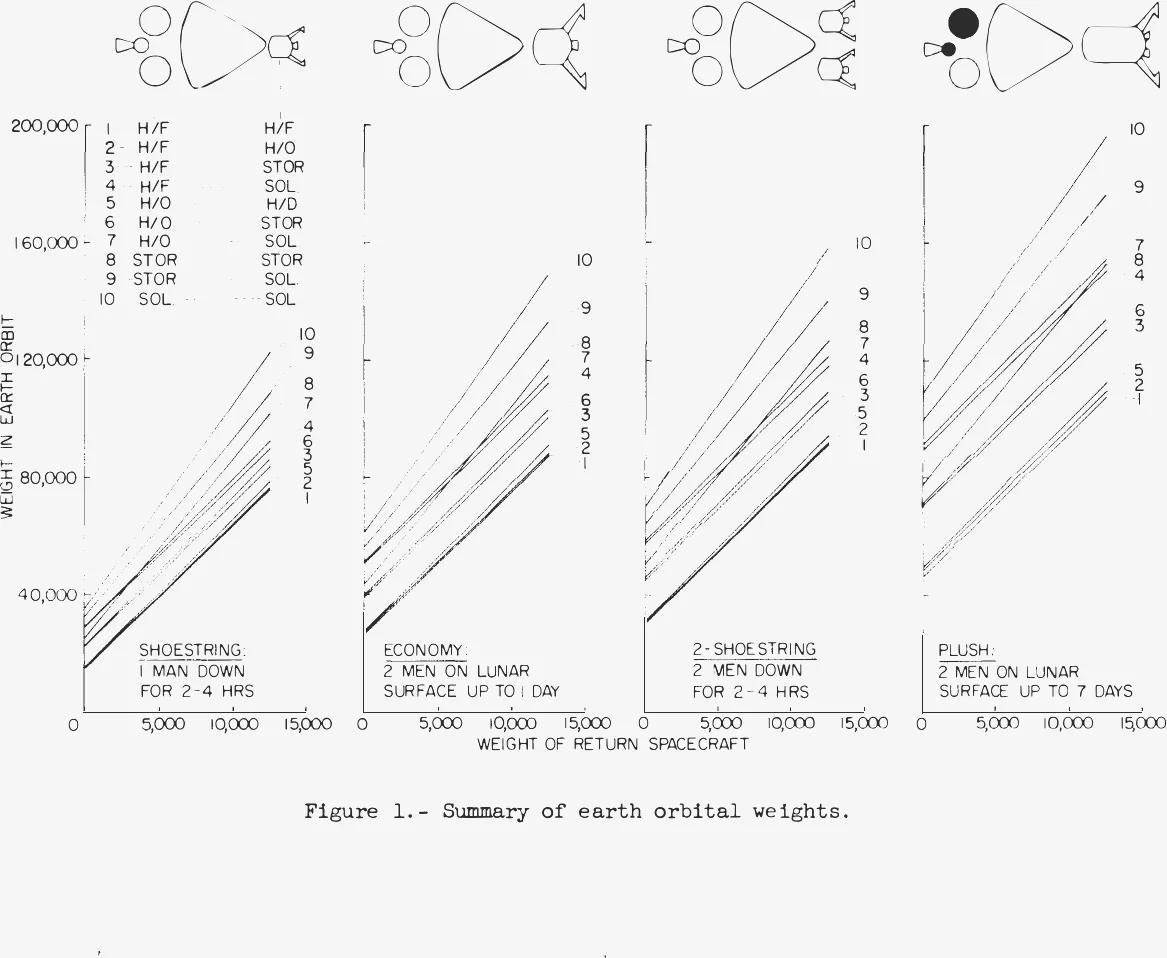
Tables IX and X carry the central claim. With the 11,000-lb return vehicle and the Economy lander, the weight needed in Earth orbit falls from 180,624 to 79,300 lb with hydrogen–fluorine, from 193,322 to 82,200 lb with hydrogen–oxygen, from 338,461 to 108,000 lb with storables, and from 533,981 to 134,000 lb with solids. That is a factor of 2.3 to 4.0. The lower-energy the propellant, the bigger the advantage, because every pound that does not have to land and take off again saves fuel on both legs.
The booster consequence is stated but cannot be checked inside the report. Many cases fit a direct boost with a C-3 vehicle, heavier ones a C-4, and the actual booster counts are not considered here because of classification (p. 19).
Program Plan and Schedulingpp. 27–33
To allow a fair comparison, the plan reuses the development schedules of the Fleming and Heaton studies and a July 1961 start. It drops the perfect vehicles in perfect supply assumption, but does no PERT network analysis. The result is a first landing in March 1966: the same as Heaton Mission C, four months ahead of Heaton A and B, and 17 months ahead of Fleming. Four landing attempts are programmed, with 100 percent spares (pp. 27–28).
The report lists seven advantages. All development happens on C-1. The lander, Apollo and the rendezvous experiments can proceed in parallel. And the schedule could tolerate 4 or 5 months slippage in C-3 and still match the Heaton A and B landing date (pp. 28–29).
| Plan | C-1 | C-3 or C-4 | Nova | Total large |
|---|---|---|---|---|
| Fleming (direct, Nova) | 28 | 27 | 17 | 72 |
| Heaton A (earth-orbit rendezvous) | 20 | 68 | — | 88 |
| Heaton B | 20 | 60 | — | 80 |
| Heaton C | 20 | 44 | — | 64 |
| Lunar rendezvous | 28 | 22 | — | 50 |
Fundingpp. 34–35
There was no time for a cost study. Instead the report assumes development costs are about the same for all methods and lets vehicle counts stand in for cost. On that basis LOR needs less than half as many C-3 vehicles as the Heaton missions and fewer than Fleming. The cost argument therefore rests entirely on Table XIII.
Safety and Reliabilitypp. 36–38
From Earth launch to lunar orbit and back, crew safety is the same for every mission mode. Rendezvous at the Moon is admitted to cost some slight degree of reliability on its own. The report argues that this is more than repaid by landing with a small, single-purpose vehicle, and that lunar rendezvous, with no atmosphere and no launch-site constraints, should be easier and more reliable than rendezvous at the earth (p. 36).
- If the lander is lost, the mother ship still returns home. A direct-landing accident leaves no return to earth (p. 37).
- Two-lander rescue: one man lands first. The second lander then descends with one man while the third stays in orbit, and both men return in the same lander. The first man down can give GCA (ground-controlled approach) assistance (p. 38).
- A C-4 is preferred over a C-3 for its margins and fewer airstarts (p. 38).
Development Programpp. 39–46
Lander development should start at once and is easier than Apollo's, since the lander never re-enters an atmosphere. Rendezvous is proven step by step: Mark II–Agena flights first, then Mark II–lander and Apollo–lander rendezvous on C-1. The early flights pilot the target vehicle remotely, for safety (pp. 39–40). Three new Langley facilities are proposed (pp. 41–42):
- Analog docking facility: an overhead three-axis carriage with a gimballed cab working against a full-scale mock-up, operational by February 1963.
- Lunar descent and take-off research facility: a fixed-base six-degree-of-freedom simulator with a 10-ft-radius spherical screen and Moon models covering simulated altitudes from 1,000 miles down to 1 mile.
- Lunar landing research facility: a full-scale gantry 400 ft long and 200 ft high, carrying vehicles of up to 20,000 lb on a cable that supports 5/6 of their weight, so the pilot feels lunar gravity.
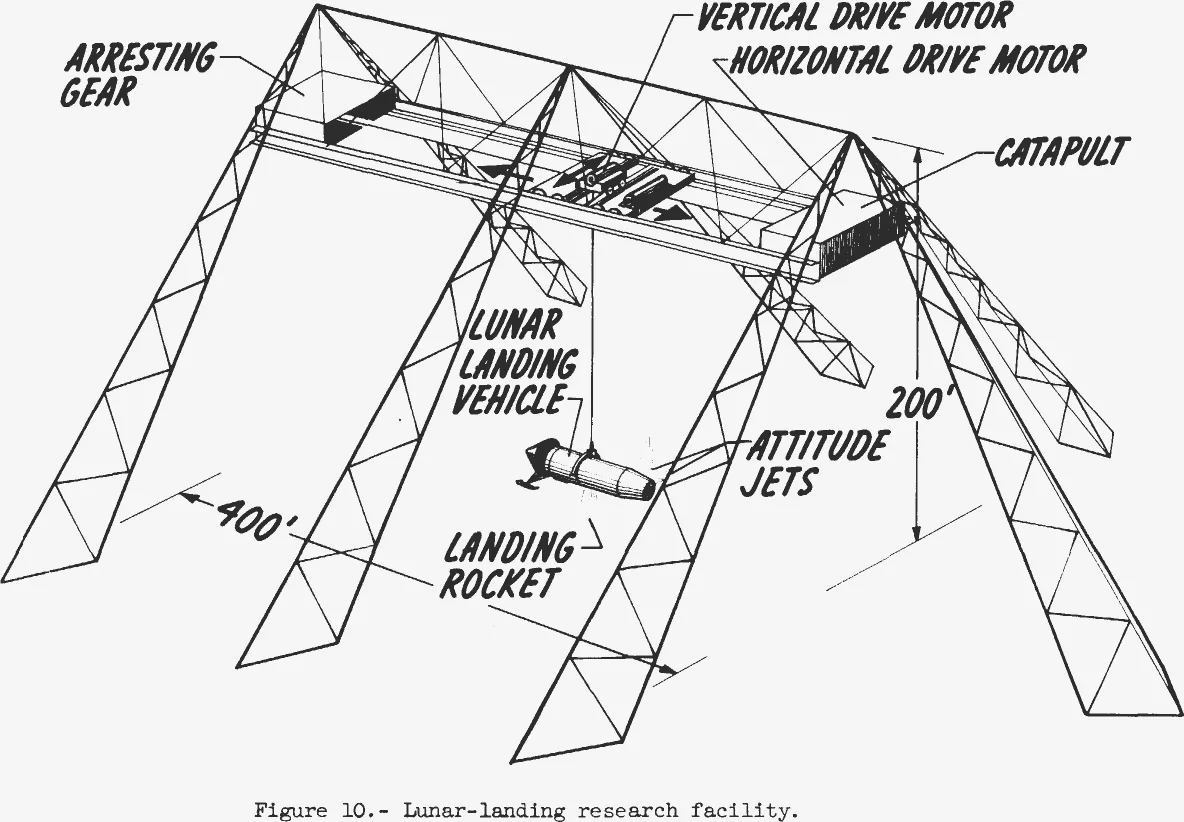
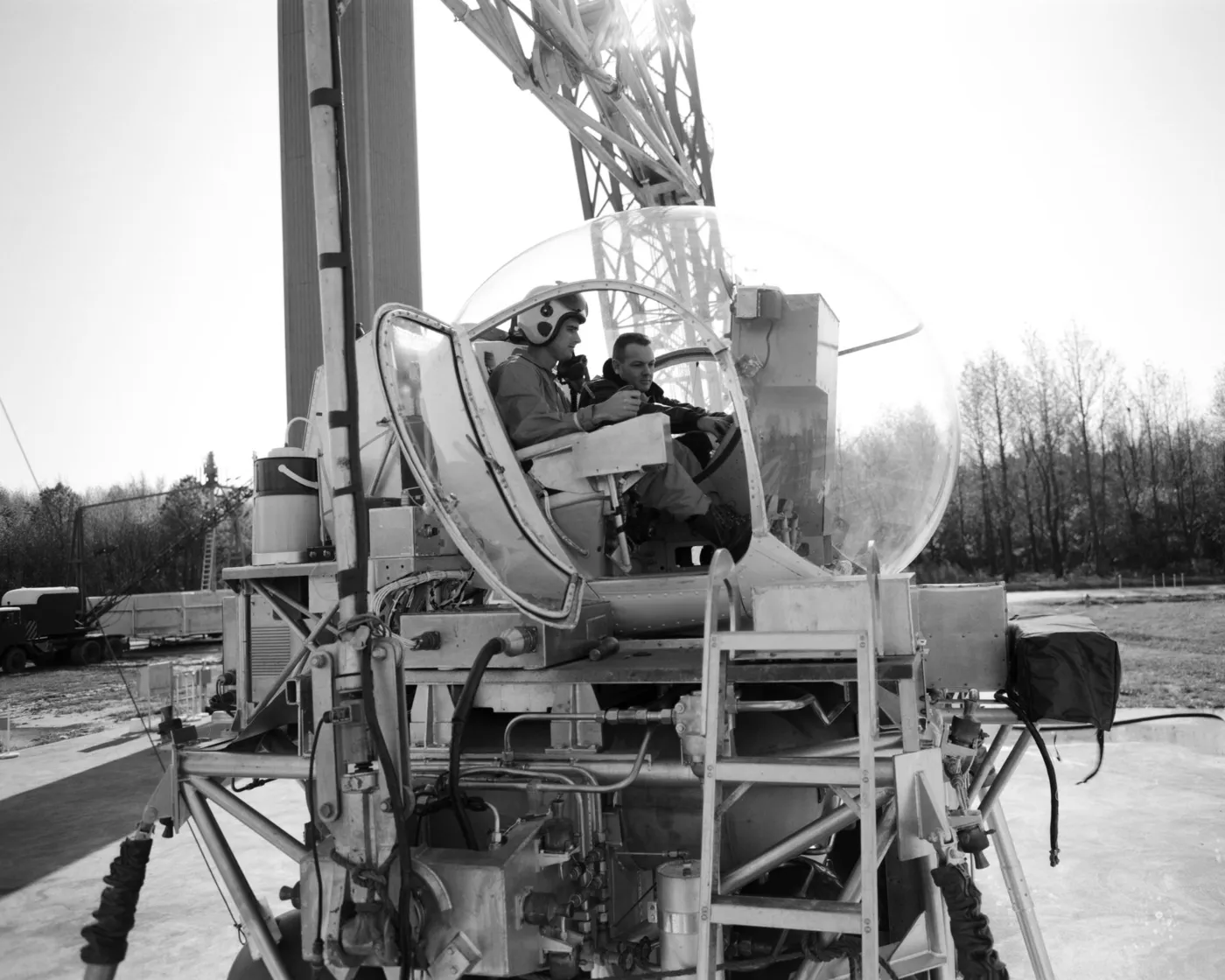
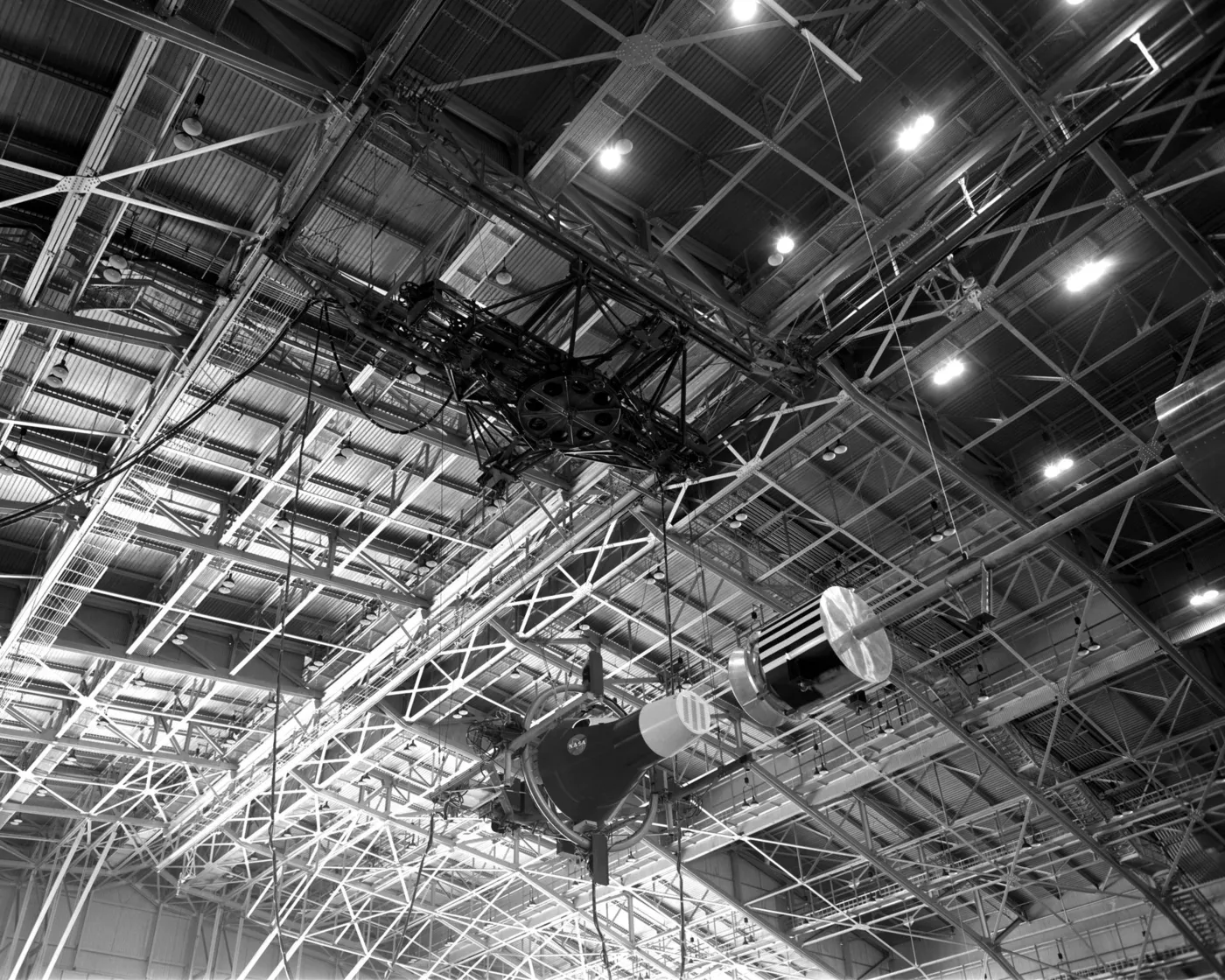
Part II · Guidance into a Lunar Orbitpp. 47–56
The spacecraft arrives on a hyperbola. A retro burn must leave it at the chosen altitude with zero radial velocity and circular speed. A horizon seeker gives the local vertical, a stellar-aligned inertial table gives attitude and integrates radial acceleration, and doppler radar takes over close in (p. 47).
| Error at cutoff | Effect |
|---|---|
| 1 ft/s in final speed | 1 mile in pericynthion |
| 1 mile in altitude | 3 miles |
| 0.1° in flight-path angle | 3 miles |
| 0.5° in retro-rocket angle | 6 miles |
| 0.1° in heading | −1/6° of inclination |
With the expected measurement accuracies (Table XV) the pericynthion error is about 12 miles, which is why 50 miles is called a safe nominal (p. 48).
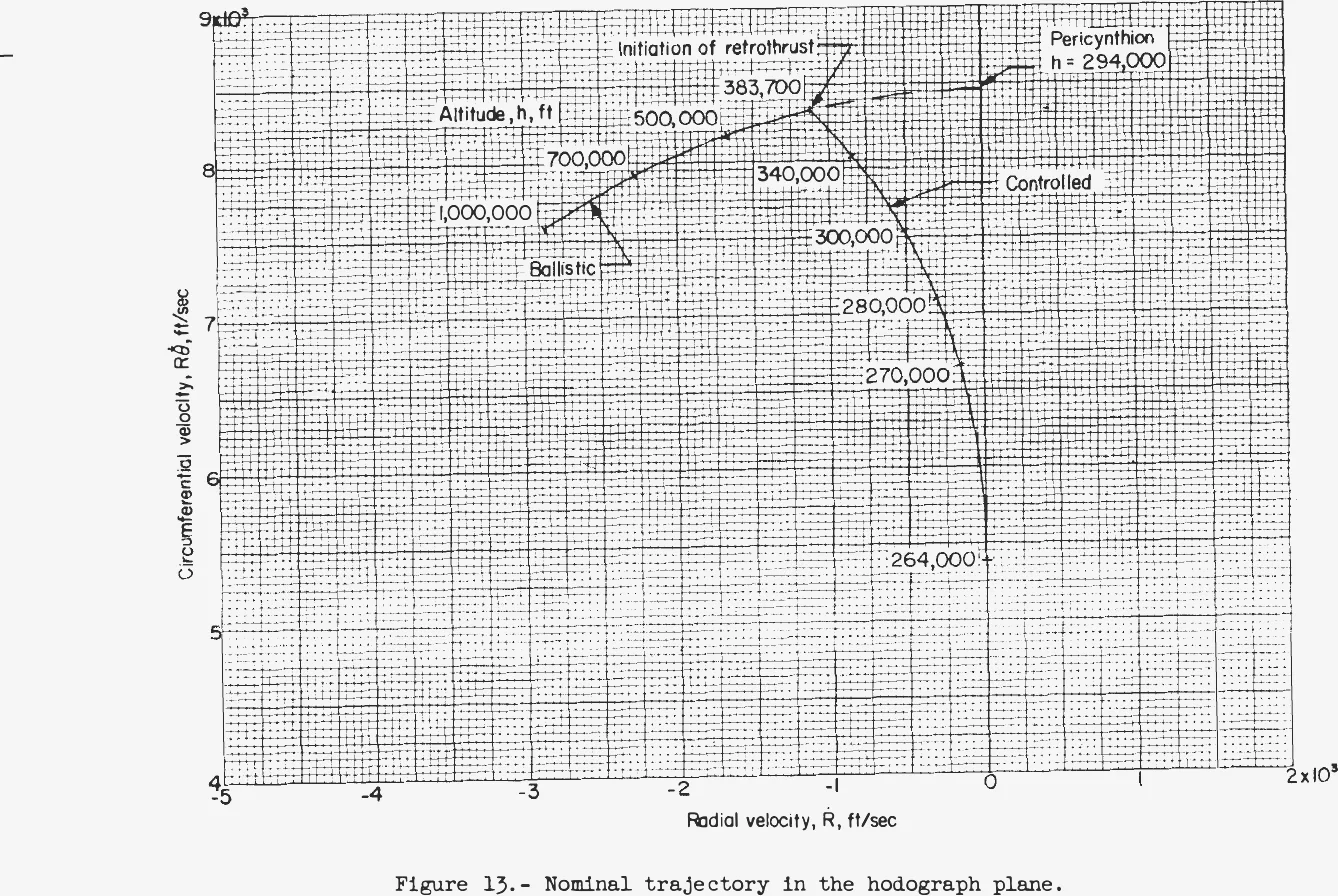
A piloted simulation (Queijo & Riley, NASA TN D-917) flew the insertion with a hodograph display: descent rate against circumferential speed. On the nominal approach, which would pass pericynthion at 294,000 ft and 8,466 ft/s, a constant 0.26-g retro burn from 383,700 ft ends in circular orbit at 264,000 ft. Pilots used 1 to 3 percent of initial mass more than an ideal two-impulse transfer: 29.2 versus 27.7 percent nominally, and 30.3 versus 28.0 percent on an off-nominal run (pp. 48–49, Figs. 14–15).
Descent to Lunar Surfacepp. 57–64
Lunar letdownpp. 57–60
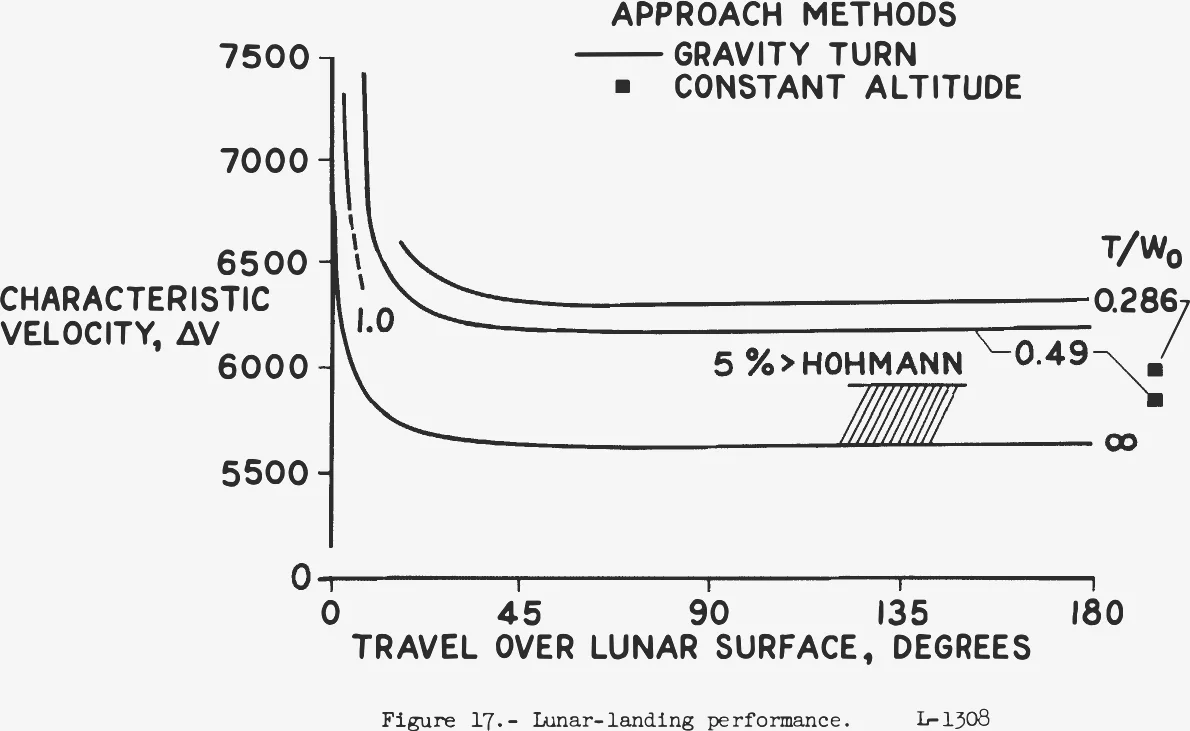
The lander separates with a small thrust so that its later rocket plume will not envelope the mother ship. The economical profile is a small deorbit impulse, a long coast and a final retro period. An ideal Hohmann descent, travelling 180° over the surface, costs 5,630 ft/s. Lower thrust-to-weight costs more because of gravity losses (Table XVIII):
| T/W₀ (Earth g) | 0.250 | 0.286 | 0.430 | 1.000 | 2.000 |
|---|---|---|---|---|---|
| ΔV, ft/s | 6,350 | 6,230 | 5,920 | 5,690 | 5,650 |
Only a 5 percent penalty over Hohmann at T/W₀ = 0.43.
Lunar landing techniquepp. 61–64
Simulator work pointed to two conclusions: a completely visual landing operation appears feasible, and pilots preferred braking at 1/4 to 1/2 Earth g. Gravity-turn descents lose about 10 percent over Hohmann. The recommended alternative brakes at nearly constant altitude, hovers, then descends vertically. It is only about 5 percent less efficient than a Hohmann Transfer and most nearly duplicates the landing approach of conventional airplanes (pp. 61–62).
- Choose the site during the first orbits, probably … in earth-shine, avoiding the glare and black shadows of the sunlit side.
- Separate and station-keep to one side, perhaps with a simple extensible-rod device.
- Half an orbit before the site, burn about 60 feet per second with the attitude rockets alone.
- Coast about an hour, in sight and radio contact with the orbiter.
- About 100 miles out, at several thousand feet, brake at nearly constant altitude using two engines gimballed sideways to keep the blast off the site.
- Hover for up to a minute or more, then descend vertically.
Lunar Launch and Rendezvouspp. 65–75
Launch is timed by the elevation of the orbiter above the horizon, so it is always in view and there is no blind launch. A pitch program carries the lander to cutoff about 10 miles up at an initial three lunar g. Then it coasts 10 to 33 minutes, depending on the coast angle, to terminal rendezvous (pp. 65–66, Figs. 19–20). A seven-day stay builds up as much as 6° of plane offset, because the Moon turns about 90° under the orbit. With 3° corrected at landing and 3° at take-off, the report puts the cost at 2.6 percent of mass ratio (p. 65).
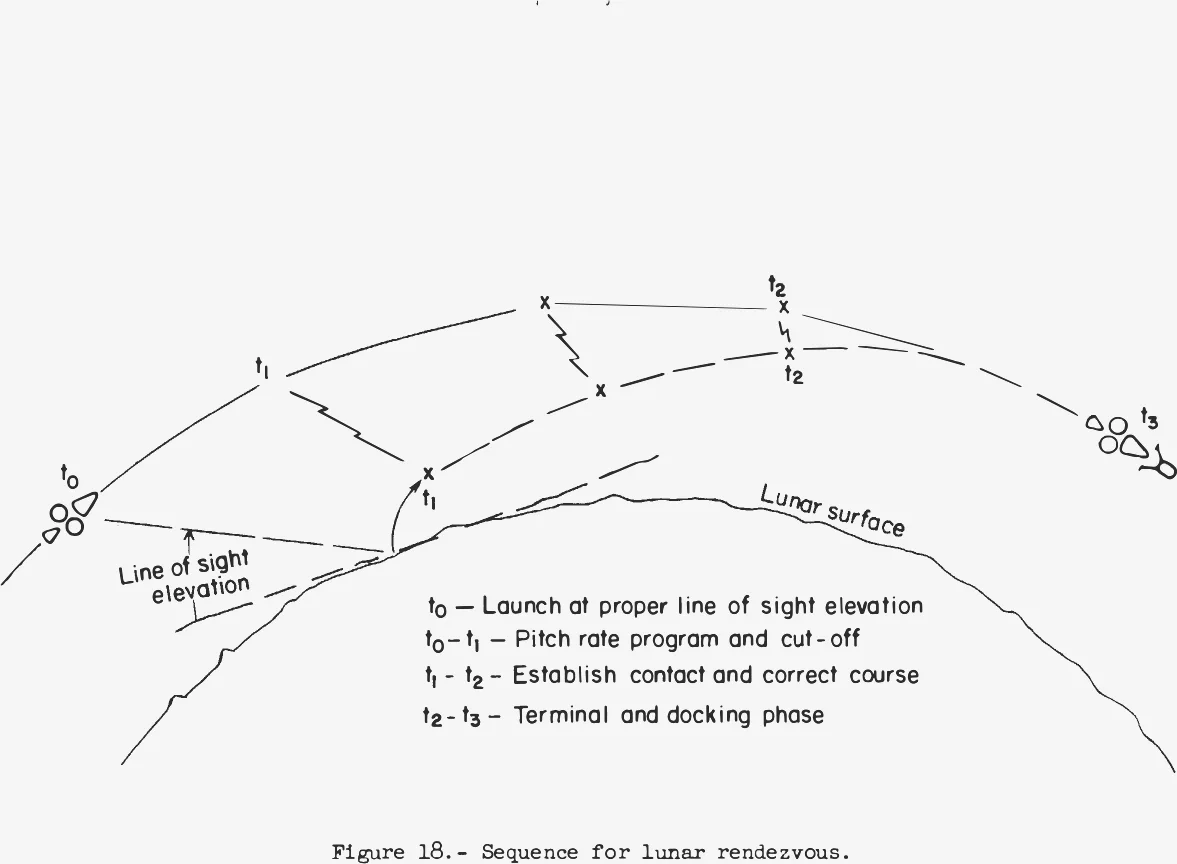
Simulations backed manual rendezvous. Pilots could overcome misaligned thrust equal to 90 percent of their attitude-control power, and a single thrust rocket is sufficient for all translational control. A visual method works by nulling the target's drift against the stars: pilots detected 1 milliradian in 10 seconds. At 50 miles, timed thrusting gave range within 2 miles or 4 percent (pp. 67–68).
Abort in All Phasespp. 76–78
Abort is the same for every mission mode except during landing, and the critical moment is just before touchdown. Assuming at most about 1½ hours between detecting a solar flare and its arrival, the lander must be able to reach the orbiter within about a revolution, which means a Hohmann-type return. That needs the orbiter a few degrees ahead. So the landing should cover at least 165° of travel from a 50-mile orbit, or 63° from a 100-mile orbit, which costs only about 100 ft/s more (pp. 76–77).
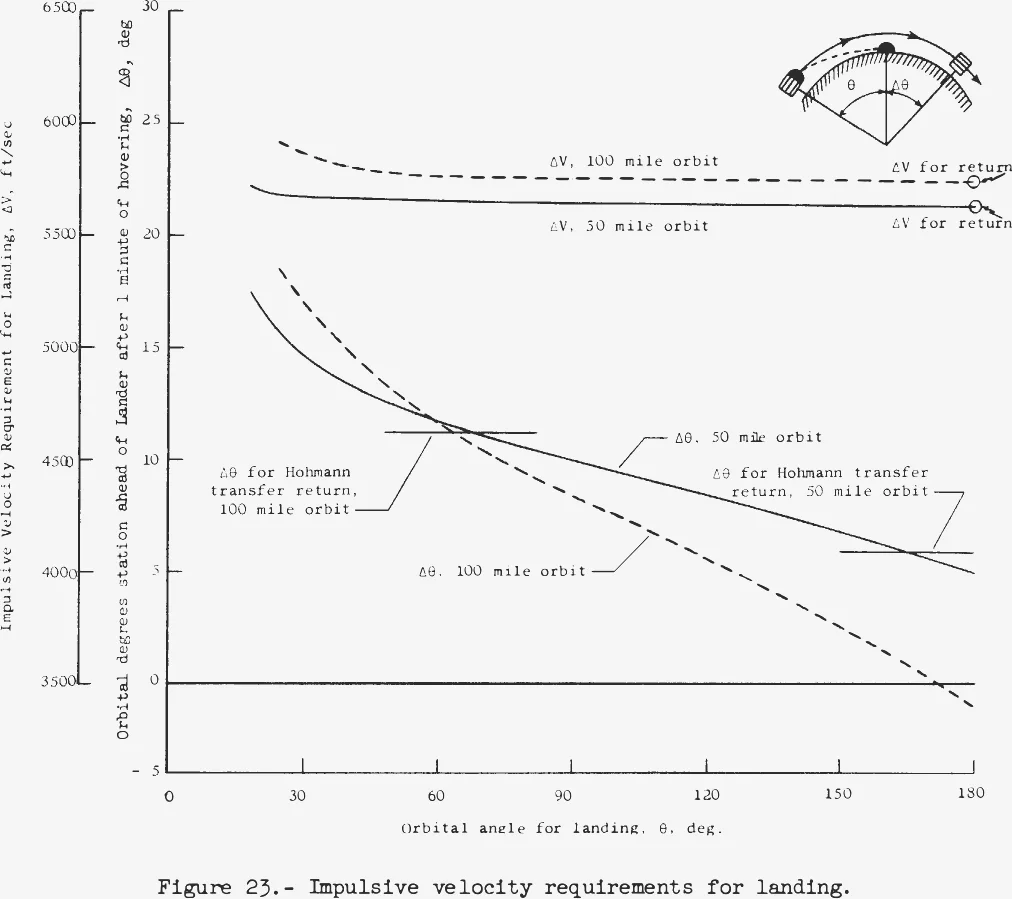
A piloted visual abort needed less than 20 percent more fuel than the impulsive ideal, about 6,900 ft/s. That is why the 7,500-foot-per-second characteristic velocity increment adopted is judged more than adequate (p. 77).
Instrumentation, Communications, Life Support, and Auxiliary Powerpp. 79–97
This section sizes the lander, here called the BUG, to work from a 50-nautical-mile lunar orbit with an Apollo type vehicle (mother ship). Guidance runs through six phases: orbit, deorbit, landing, launch, rendezvous and docking. It needs an onboard digital computer of 80w, weight 45 lb, volume 0.4 cu ft with 22 bits per word (pp. 79–81).
| Equipment | Measures | Weight, lb | Power, W |
|---|---|---|---|
| Radar altimeter (high) | h, ḣ above 2,000 ft | 25 | 75 |
| Radar altimeter (low) | h, ḣ below 2,000 ft | 15 | — |
| Doppler radar | tangential velocities | 16 | 40 |
| Rendezvous radar | r, ṙ, angles and rates | 54 | 200 |
| Inertial platform | attitude, h, ḣ, velocities | 60 | 100 |
| Computer | 45 | 80 | |
| Rate gyros | p, q, r | 8 | 25 |
| Pilot display | 11 | 30 | |
| Visual line of sight | angles and rates | 5 | 2 |
| Total | 239 | 552 |
About 3,300 Wh for six hours of operation. A minimal set would weigh about 110 lb and draw 180 W (p. 85).
Communications are voice only, on S-band. Life support assumes a shirtsleeve cabin with no airlock, repressurised after each excursion. Each vehicle needs about 6.6 lb of oxygen, 5.6 lb of lithium hydroxide, 5 lb of drinking water, 2 lb of food and 5 lb of repressurisation oxygen per day. Beyond about three days a regenerative system wins (pp. 82–85). For primary power, batteries win on short stays and a fuel cell on long ones:
The Radiation Hazardpp. 98–99
Only the 26 hours from deorbit to rendezvous differ between mission modes. Galactic cosmic rays add about 0.07 rem, negligible against a 5-rem mission allowance. Big solar flares are another matter. Behind 2 g/cm² of shielding, the May 1959 event would have delivered about 2,000 rep and the February 1956 event about 350, both far above the 100-rem emergency dose. Even a 2½-hour dash back to orbit would absorb 500 or 250 rep at the initial rates. The conclusion: rely on flare prediction for one-day stays, and plan shelters (2 feet of lunar material should adequately shield) for longer ones.
Weightlessnessp. 100
Apollo already accepts weightlessness, and rotating the craft is impractical. Exercise is the countermeasure. For a one-day (26-hour) stay, the lander needs no exercise equipment.
Assumptions and open questions
Key assumptions
- Return-vehicle weights of 8,500, 11,000 and 12,500 lb are ground rules of the study (p. 18), not designs.
- One propulsion module brakes the stack into lunar orbit and later launches the return vehicle home, so its tanks serve both burns (p. 18).
- Lander weights start from the itemised estimates of Table V (1,270–3,957 lb without tanks), and the whole basic weight, samples included, returns to orbit.
- Every velocity increment carries finite-thrust and piloting allowances, with non-optimum conditions assumed for each phase (p. 12).
- Development costs are taken as roughly equal across mission modes, so vehicle counts stand in for cost (p. 34).
- Solar-flare warning of about 1½ hours, and flare prediction 2–4 days ahead, frame the abort and radiation planning (pp. 76, 98–99).
Where further work would help
- Sensitivity to lander weight. The Earth-orbit weights scale with the Table V estimates. A sweep of lander dry weight, beyond the three sizes studied, would show how much margin the single-launch conclusion has.
- Booster capability. Translating weights into launch vehicles needs the C-3 and C-4 payloads that the report withholds for classification (p. 19).
- The lunar surface. Bearing strength, dust and site characterisation shape the landing gear and the visual-landing technique. The report notes its site-survey plans are not completely adequate (p. 28).
- Operations at night and out of sight. Earthshine landings, rendezvous lighting and communication while behind the Moon are discussed only qualitatively.
- Scaling up. Longer stays (the 7-day Plush lander) and larger crews raise questions of radiation shelter, life-support regeneration and power that the report sizes only to first order.
- Cost and schedule. Detailed cost and network-schedule analyses would test how far the vehicle-count comparison carries over to program cost.
What happened next
- 1961
Oct 31: Langley completes this two-volume report. In mid-October the Golovin Committee had recommended a hybrid of Earth-orbit and lunar-orbit rendezvous.
- 1961
Nov 15: Houbolt writes directly to Associate Administrator Robert Seamans, somewhat as a voice in the wilderness.
- 1962
Apr–Jun: Houbolt sends the published report to Wernher von Braun, who endorses LOR at Marshall on 7 June.
- 1962
Jul 11: NASA announces LOR as Apollo's mission mode, after the Manned Space Flight Management Council favoured it on 22 June.
- 1969
Jul 20: Apollo 11 lands at Tranquility Base, on a single three-stage Saturn V with a two-man lunar module and a three-man crew. Fig. 24 of the report had sketched its notional landing at the edge of Mare Tranquillitatis.
Sources
- Manned Lunar-Landing through use of Lunar-Orbit Rendezvous, Vol. I (1961), scan · Not in the public NTRS index
- J. R. Hansen, Enchanted Rendezvous: John C. Houbolt and the Genesis of the Lunar-Orbit Rendezvous Concept (NASA SP-4504)
- NASA: 60 Years Ago, NASA Decides on Lunar Orbit Rendezvous for Moon Landing
- Bird & Thomas, A Parametric Investigation of the Lunar-Orbit-Rendezvous Scheme (NASA TN D-1623, 1963)
- NASA Image Library: Houbolt at the blackboard, 1962
- NASA Image Library: Rendezvous Docking Simulator, 1963
- NASA Image Library: Lunar Landing Research Facility, 1965